The most strategic energy chokepoint on the planet
Few places on Earth concentrate as much economic, military, and geopolitical importance in such a small area as the Strait of Hormuz. Located between Iran and Oman, this narrow maritime passage connects the Persian Gulf to the Gulf of Oman and, ultimately, to the Arabian Sea and the Indian Ocean. Despite being only a few dozen kilometers wide at its narrowest point, it plays an enormous role in the functioning of the global economy.
Every day, a significant portion of the world’s energy supply passes through this maritime corridor. Giant oil tankers transport millions of barrels of crude oil and large volumes of liquefied natural gas destined for economies across Asia, Europe, and other regions. Any disruption in this flow has the potential to immediately shake global energy markets and directly affect prices, inflation, and economic stability.
More than just a shipping route, the Strait of Hormuz is one of the most sensitive geopolitical flashpoints in the world. Its strategic position, combined with the heavy military presence in the region and the long-standing tensions involving Iran, the United States, and Gulf states, has led analysts to frequently describe it as one of the most dangerous locations on Earth from a strategic perspective.
Understanding what the Strait of Hormuz is and why it matters so much helps explain many of the tensions that shape international politics today.
Where the Strait of Hormuz is located
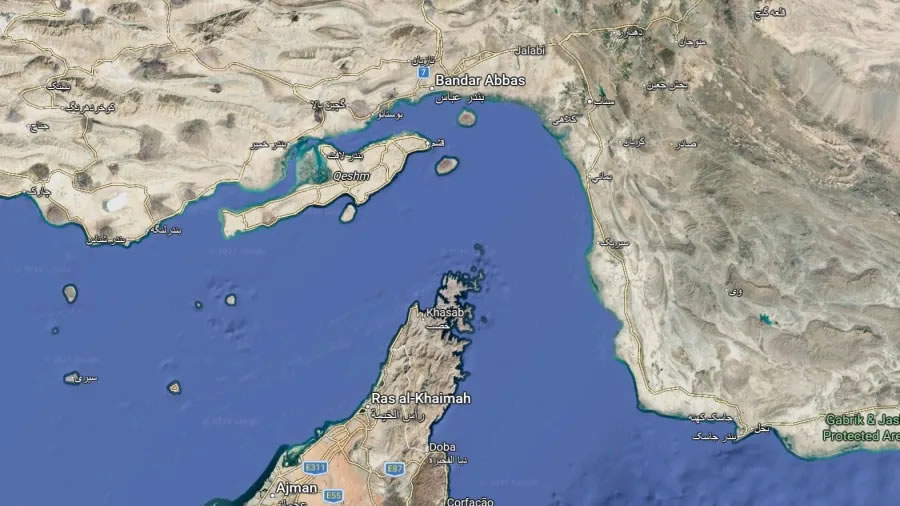
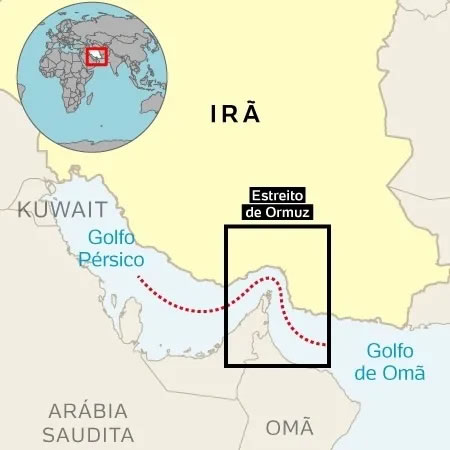
The Strait of Hormuz lies in the Middle East, separating Iran to the north from the Musandam Peninsula, which belongs to Oman, to the south. It forms the only maritime passage between the Persian Gulf and the Gulf of Oman, which opens into the Arabian Sea and the wider Indian Ocean.
This connection is crucial because the Persian Gulf contains some of the largest oil and natural gas reserves on the planet. Countries such as Saudi Arabia, Iran, Iraq, Kuwait, the United Arab Emirates, and Qatar rely heavily on this passage to export much of their energy production to the rest of the world.
At its narrowest point, the Strait of Hormuz is about 33 kilometers wide. However, the space effectively used for navigation is much smaller. Shipping lanes are divided into two corridors of roughly three kilometers each—one for inbound traffic and another for outbound vessels.
This configuration turns the area into a genuine maritime bottleneck. In other words, it is a point where enormous volumes of global trade must pass through a relatively small and predictable corridor.
One of the world’s main energy corridors
The Strait of Hormuz is widely considered the most important energy chokepoint on Earth. The term “chokepoint” refers to a strategic location where a large flow of resources—such as oil or gas—must pass through a narrow and constrained passage.
It is estimated that roughly 20 percent of all oil traded worldwide passes through the Strait of Hormuz each day. This corresponds to something between 17 and 20 million barrels of oil daily, depending on global production levels and market conditions.
In addition to crude oil, a substantial portion of the world’s liquefied natural gas (LNG) also travels through the strait, particularly exports from Qatar, one of the largest LNG producers on the planet.
Much of this energy supply is destined for countries that depend heavily on imported energy. Major importers include China, Japan, South Korea, India, and several European nations.
This reliance means that any instability in the region is closely watched by governments, financial markets, and energy companies across the globe.
Why the strait is so strategic
The importance of the Strait of Hormuz lies not only in the enormous volume of energy that passes through it but also in how difficult it would be to replace this route.
There are a few pipelines and alternative export routes that allow some oil from the Persian Gulf to bypass the strait. Saudi Arabia, for instance, operates a pipeline that crosses the kingdom and reaches the Red Sea, enabling part of its oil production to be exported from the port of Yanbu.
The United Arab Emirates also built infrastructure linking inland oil fields to the port of Fujairah, located outside the Persian Gulf.
However, these alternatives have limited capacity and cannot fully replace the massive volumes that normally move through the Strait of Hormuz. Even if all available alternative routes were used at maximum capacity, a substantial share of Gulf oil exports would still depend on the strait.
This means that a prolonged disruption could remove millions of barrels of oil per day from the global market, placing enormous pressure on supply chains and energy prices.
The global impact of a potential blockade
If the Strait of Hormuz were effectively blocked, the consequences would be felt almost immediately across the world.
The first and most obvious impact would occur in the oil market. A sudden interruption of millions of barrels per day could trigger a severe supply shock. Analysts frequently estimate that oil prices could surge to levels between 150 and 300 dollars per barrel in a full blockade scenario.
Such an increase would directly affect fuel prices. Gasoline, diesel, and aviation fuel would become significantly more expensive in many countries.
Because modern economies depend heavily on fuel for transportation and logistics, higher energy prices would ripple through global supply chains. Shipping costs would rise, manufacturing would become more expensive, and the price of goods would increase.
This dynamic would quickly translate into global inflation. Food prices, industrial products, and consumer goods could all rise as transportation and production costs climb.
Financial markets would likely react strongly to such instability. Stock markets could experience sharp declines, while governments and central banks would face pressure to manage the combination of high inflation and slowing economic growth.
History shows that major disruptions in oil supply often lead to economic crises. The oil shock of 1973, triggered by an embargo from oil-producing countries, caused severe economic turmoil in many Western economies. Another major shock occurred in 1979 after the Iranian Revolution disrupted oil production and exports.
One of the most dangerous geopolitical flashpoints in the world
The economic importance of the Strait of Hormuz is only part of the story. The region is also one of the most militarized maritime zones on Earth.
On one side lies Iran, a major regional power that controls most of the northern coastline of the strait. On the other side are Gulf monarchies that maintain close strategic ties with the United States and Western allies.
The United States maintains a permanent military presence in the region through the U.S. Navy’s Fifth Fleet, headquartered in Bahrain. Aircraft carriers, destroyers, submarines, and patrol vessels frequently operate in the Persian Gulf and surrounding waters.
Other countries, including the United Kingdom and France, also participate in maritime security operations aimed at protecting international shipping routes.
The concentration of military forces in such a narrow and strategically critical area increases the risk that incidents could escalate into larger confrontations.
Why Iran is capable of threatening the strait
Although Iran’s navy is significantly smaller than that of the United States and other Western powers, the country has developed strategies designed to counter stronger adversaries through asymmetric warfare.
Rather than attempting to compete directly with large naval fleets, Iran focuses on tactics that exploit the vulnerabilities of ships operating in the confined environment of the Persian Gulf.
One of these tactics involves the use of small, fast attack boats equipped with missiles, rockets, and heavy machine guns. These vessels can operate in large numbers and conduct coordinated swarm attacks against larger ships.
Another critical component of Iran’s strategy is the use of naval mines. These explosive devices can be placed on the seabed or anchored near the surface. Even a relatively small number of mines can turn a busy shipping route into a dangerous zone for commercial vessels.
Mine clearance operations are complex and time-consuming, often requiring specialized equipment and weeks of careful work to ensure safe navigation.
Iran also deploys anti-ship missiles along its coastline and on nearby islands overlooking the strait. Some of these missiles are capable of striking targets hundreds of kilometers away.
In recent years, the country has also expanded its arsenal of attack drones and surveillance systems, which enhance its ability to monitor maritime traffic and strike targets if necessary.
Coastal control and strategic positioning
Geography also plays an important role in Iran’s ability to threaten shipping in the Strait of Hormuz.
The country controls most of the northern coastline along the strait and maintains a presence on several strategic islands near the shipping lanes. These locations allow the deployment of radar systems, surveillance equipment, and missile batteries capable of monitoring vessel movements.
Because ships traveling through the strait must follow clearly defined navigation corridors, their routes are highly predictable. This predictability makes it easier for military forces to track and potentially target vessels passing through the area.
The power of economic deterrence
A crucial aspect of Iran’s strategy is that it does not necessarily need to completely close the strait to generate global consequences.
It only needs to make navigation dangerous enough for shipping companies and insurers to consider the route too risky.
If oil tankers begin to face attacks, mines, or seizures, insurance costs could rise dramatically. In some cases, insurers might even refuse to cover ships traveling through the region.
Without insurance, most commercial vessels would simply avoid the route.
In such a scenario, the Strait of Hormuz could become effectively closed in practice, even if no official blockade were declared.
Historical episodes of tension
The region has experienced multiple periods of tension over the past several decades.
During the Iran-Iraq War in the 1980s, a phase of the conflict known as the “Tanker War” saw attacks on commercial shipping and oil tankers in the Persian Gulf. These attacks forced several nations to deploy naval escorts to protect maritime trade.
More recently, incidents involving the seizure of tankers, sabotage operations, and confrontations between Iranian forces and Western naval units have once again placed the Strait of Hormuz at the center of global attention.
A small passage with global consequences
The Strait of Hormuz demonstrates how a relatively small geographic space can have an outsized influence on the global economy.
It combines an extraordinary concentration of energy flows with intense geopolitical rivalries and heavy military presence. Because of this combination, any instability in the region can rapidly send shockwaves through energy markets and international politics.
More than just a maritime passage, the Strait of Hormuz functions as a barometer of Middle Eastern tensions and remains one of the most sensitive points in the global energy system.