




Capybara: the laid-back philosophy of the world’s largest rodent
It doesn’t run without reason. It doesn’t fight over territory as if it were the end of the world. It shares space, accepts company, slips into the water when the heat hits, and comes out when it feels like it. The capybara, the largest living rodent on the planet, seems to follow a logic of its own — a blend of biological pragmatism and an almost philosophical serenity.
But behind the fame of the “internet’s zen animal” lies an ancient evolutionary story, an essential ecological role in South American ecosystems, and an increasingly complex relationship with humans — especially in cities.
Origin and identity: what is a capybara?
The capybara (Hydrochoerus hydrochaeris) is a rodent mammal native to South America and belongs to the family Caviidae — the same family as guinea pigs. Its scientific name already reveals a lot about its nature:
- Hydro = water
- choerus = pig
In other words, something like “water pig.” And that’s not an exaggeration: water is the central axis of a capybara’s life.
An adult can exceed 60 kg — and in some recorded cases, approach 80 kg. It measures between 1 and 1.3 meters in length and about 50 to 60 cm in height. Its body is robust and barrel-shaped, with partially webbed feet and a broad head.
Its eyes, ears, and nostrils sit high on the skull — a perfect adaptation for scanning the surroundings while remaining almost fully submerged, a typical behavior of semi-aquatic animals.
Like all rodents, capybaras have continuously growing incisors. These teeth must be constantly worn down by intense chewing of fibrous vegetation. It’s a biological machine built to graze.
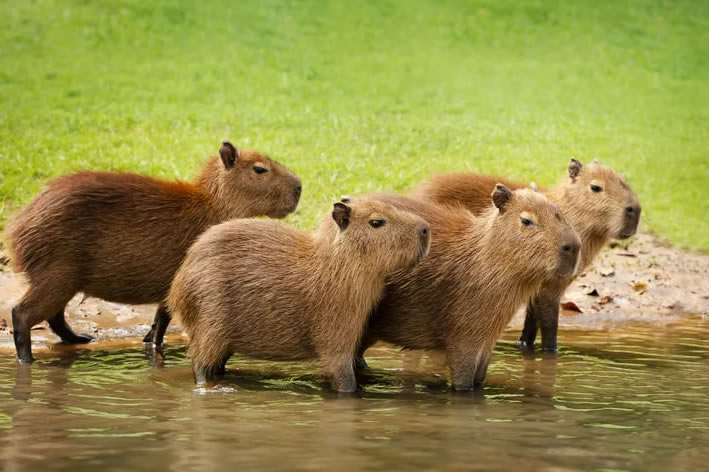
An ancient evolutionary history
The capybara lineage goes back millions of years. Its ancestors belonged to a group of giant rodents that inhabited South America during the Miocene and the Pliocene.
Among these extinct relatives was the impressive Josephoartigasia monesi, considered the largest rodent ever recorded in history, potentially exceeding a ton. In a way, the modern capybara is a miniaturized heir to that age of giants.
Evolution shaped the species to exploit aquatic environments and flooded margins — niches rich in food and with less direct competition from other terrestrial herbivores.
Taxonomic classification: where does the capybara fit in the tree of life?
The capybara is not just “a big rodent.” It occupies a very specific position within the biological hierarchy that organizes all living beings. Its taxonomic classification is as follows:
Kingdom: Animalia
Phylum: Chordata
Class: Mammalia
Order: Rodentia
Suborder: Hystricomorpha
Family: Caviidae
Subfamily: Hydrochoerinae
Genus: Hydrochoerus
Species: Hydrochoerus hydrochaeris
Let’s translate that into meaning.
It belongs to the Kingdom Animalia — meaning it is a multicellular, heterotrophic animal with a developed nervous system.
It is in the Phylum Chordata, the group that includes all animals with a notochord at some stage of life — the same broad group that includes fish, amphibians, reptiles, birds, and mammals.
In the Class Mammalia, we find mammals: animals that have hair, mammary glands, and internally regulated body temperature.
The Order Rodentia is the most diverse group of mammals on the planet. More than 40% of mammal species are rodents. What defines this group is continuously growing incisors — exactly the case with the capybara.
Within the suborder Hystricomorpha are the so-called “caviomorph” rodents, a typically South American group that includes guinea pigs, agoutis, and pacas.
The family Caviidae includes robust-bodied animals and specialized herbivores. The capybara is, essentially, the “giant” of this family.
Is there more than one capybara species?
Yes — and that’s not talked about much.
In addition to the best-known species (Hydrochoerus hydrochaeris), there is another species called:
Hydrochoerus isthmius
Known as the lesser capybara, it occurs mainly in the Panama region, Colombia, and northwestern South America.
The difference between the two species involves:
- Slightly smaller size
- Subtle differences in the skull
- Distinct geographic distribution
For a long time, it was believed there was only one species. More recent genetic studies helped to formally separate the two.
This shows that even a “popular” animal still holds scientific details that are evolving.
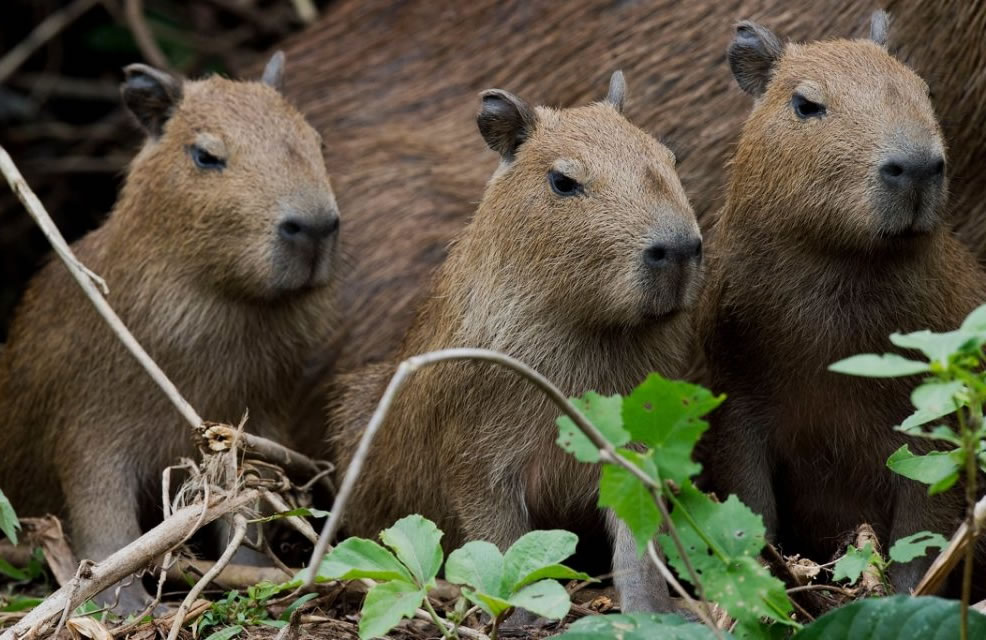
Close relatives: who are the capybara’s “cousins”?
Within the family Caviidae, the closest relatives include:
- Guinea pig (Cavia porcellus)
- Wild cavy (preá)
- Agouti
- Paca (although it belongs to another closely related family within caviomorphs)
In other words: biologically speaking, the capybara is like a “guinea pig on a monumental scale.”
The difference is that evolution pushed its lineage toward aquatic environments, increasing body size and adapting its anatomy for a semi-aquatic life.
What does taxonomy reveal about its evolutionary success?
The capybara’s taxonomic position helps explain three key aspects:
- Efficient herbivorous specialization
- Adaptation to tropical South American environments
- A cooperative social strategy
It isn’t big by accident. Its size offers advantages:
- Greater digestive capacity
- Better thermal retention
- Lower vulnerability to mid-sized predators
But that size was only possible within an ecosystem that offered abundant vegetation and constant water resources.
Geographic distribution: a South American success story
The capybara is distributed across nearly all of South America east of the Andes. It is found in countries such as:
- Brazil
- Argentina
- Colombia
- Venezuela
- Paraguay
- Uruguay
- Peru
It inhabits:
- Floodplains
- River and lake shores
- Marshes and swamps
- Seasonally flooded regions
- Reservoirs and artificial lagoons
The Brazilian Pantanal is one of its largest natural strongholds, but its presence has expanded strongly into urban areas in recent decades.
The rule is simple: where there is permanent water + abundant vegetation + relative tranquility, capybaras thrive.
Social structure: democracy in the marsh
Group living is one of the pillars of capybara survival. Herds can range from 5 to 20 individuals, but larger aggregations have been recorded during drought periods, when many animals concentrate near the few available water sources.
Typically, there is:
- A dominant male
- Several adult females
- Young of different ages
- Subordinate males
Hierarchy exists, but it rarely involves serious violent confrontations. Group cohesion increases vigilance against predators and improves survival chances.
Capybaras recognize individuals by scent and vocalization. There is evidence of long-lasting social bonds within groups.
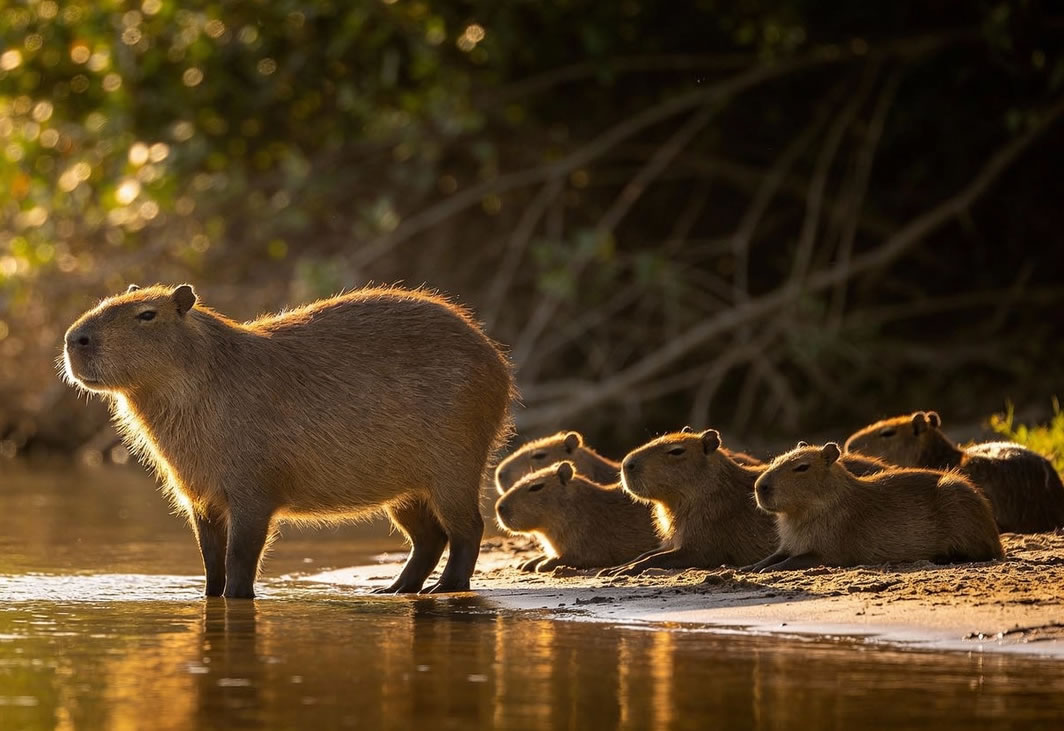
A visceral relationship with water
Water is shelter, an escape route, a thermal regulator, and a resting space.
When threatened, the capybara runs toward the nearest body of water and dives in. It can remain submerged for up to five minutes, leaving only its snout exposed — or hidden entirely under aquatic vegetation.
In addition:
- Water helps regulate body temperature on hot days
- It reduces parasite infestation
- It serves as a resting area
Some capybaras sleep partially submerged, keeping only their noses above water.

Diet: efficient digestive engineering
Capybaras are generalist herbivores, but they prefer grasses. Their diet includes:
- Grasses
- Short grasses
- Aquatic plants
- Shoots
- Young leaves
Their digestive system is highly adapted to ferment plant fibers. They have a large cecum, where bacteria help break down cellulose.
An essential behavior is coprophagy: the re-ingestion of specific feces rich in nutrients and beneficial bacteria. This allows them to make the most of proteins and vitamins synthesized during digestion.
It’s efficient biology, not eccentricity.
Reproduction and population dynamics
Gestation lasts about 150 days. Litters range from 1 to 8 pups, averaging between 3 and 5.
The young:
- Are born with fur
- Can see
- Walk within a few hours after birth
- Follow the group early on
Sexual maturity can be reached a little over one year of age.
In natural environments, populations are regulated by predators and available resources. In urban areas, that regulation weakens — resulting in accelerated population growth.
Natural predators
In the wild, capybaras face:
- Jaguars
- Ocelots
- Pumas (cougars)
- Anacondas
- Caimans
Their survival strategy combines collective vigilance and a quick retreat to the water.
In cities, these predators are virtually absent. The result is population imbalance — not because capybaras are “to blame,” but because the environment has been transformed.
Ecological role: a landscape engineer
Capybaras play relevant ecological roles:
- They control plant biomass
- They shape shoreline vegetation
- They are a key prey species for large carnivores
- They support birds that remove parasites
They influence the dynamics of plants, insects, and predators. In natural areas, their presence is integrated into a complex ecological web.
Capybaras in cities: a delicate coexistence
Urban parks offer everything they need:
- Constant water
- Large lawns
- Lack of predators
- Low levels of harassment
The most common human mistake is feeding capybaras. This changes natural patterns, reduces fear of humans, and intensifies population growth.
Another sensitive point involves ticks of the genus Amblyomma, associated with the transmission of Brazilian spotted fever in certain regions. This requires technical management and public policies based on science — never panic or violence.

Communication and vocalizations
Despite their quiet image, capybaras produce a variety of sounds:
- Warning whistles
- Clicks
- Short barks
- Soft grunts between mothers and pups
Their communication is sophisticated and contextual. The apparent silence is simply energy economy.
Longevity and life cycle
In the wild, they live on average 8 to 10 years. In controlled environments, they can exceed that.
Juvenile mortality is higher in natural environments due to predation. In urban areas, that rate tends to decrease — another factor that contributes to population growth.
Capybaras in culture and the collective imagination
In recent years, the capybara has become a global phenomenon. Relaxing videos, gentle soundtracks, and memes have viralized the “capybara mood.”
It became:
- An informal mascot of peace
- A symbol of calm amid chaos
- An icon of tolerance
The image of capybaras coexisting with ducks, cats, and even monkeys reinforces this narrative.
But the fascination is not only aesthetic — it’s symbolic. In a fast-paced world, the capybara represents slowing down.
Additional curiosities
- They are excellent swimmers
- They can run up to 35 km/h over short distances
- They have scent glands used for social marking
- They are most active at dawn and dusk
- They can adapt their schedules in urban areas
A biological philosophy
The capybara doesn’t try to dominate the environment. It adapts to it.
It isn’t aggressive without cause. It doesn’t waste energy. It lives in groups. It uses water as refuge. It chews patiently. It observes.
Maybe that’s where human fascination comes from: it symbolizes efficiency without hysteria, presence without showiness, coexistence without unnecessary conflict.
If there is an animal that sums up the philosophy of “less drama, more water, more community, and more calm,” it’s the capybara.
And there it is, chewing grass, watching everything, never in a hurry — while the world runs all around it.