
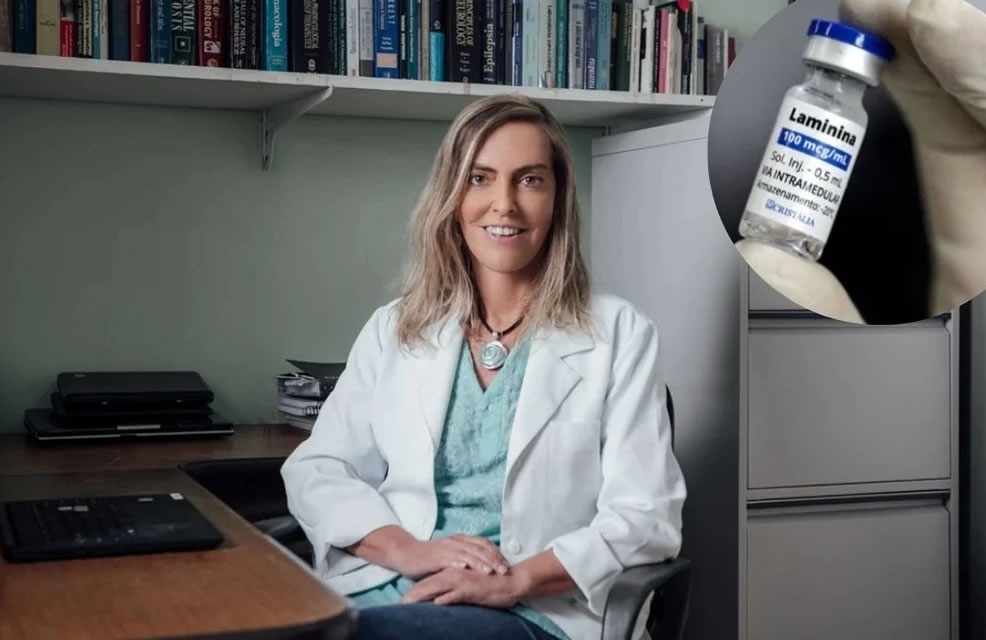
Tatiana Sampaio: the Brazilian scientist who placed neural regeneration at the center of the global debate
In recent years, the name Tatiana Sampaio has been circulating widely not only in academic circles, but also across social media, major newspapers, and television programs. The reason: research that may represent a turning point in regenerative medicine, especially in the treatment of spinal cord injuries.
But who is Tatiana Sampaio, really? Where did she come from? How was she trained? And why has her work been regarded by many as one of the most promising ever produced by Brazilian science in recent decades?
This is an in-depth analysis of her trajectory, her research, and the potential impact of her discovery on the world.
Origins and education: a trajectory built within science
Tatiana Sampaio built virtually her entire academic career within the Federal University of Rio de Janeiro (UFRJ), one of the most traditional teaching and research institutions in Latin America.
With a degree in Biological Sciences, she went on to pursue a master’s and a doctorate at the same institution, specializing in cellular and molecular biology—fields that investigate the intimate mechanisms of how cells function, their structures, and their interactions.
Early on, her interest focused on something highly specific yet fundamental: the extracellular matrix. This is the “environment” that surrounds cells—a complex network of proteins and molecules that provides structural support, chemical signaling, and organization to the body’s tissues.
It is within this microenvironment that many answers to regeneration, healing, and cellular rebuilding may be hidden.
After completing her doctorate, Tatiana carried out postdoctoral periods abroad, including research centers in the United States and Europe. This international exchange expanded her scientific repertoire and integrated her into global collaboration networks—something essential for those aiming to develop internationally impactful science.
The researcher and the laboratory
Back in Brazil, Tatiana established herself as a professor and researcher at UFRJ, where she went on to lead the Laboratory of Extracellular Matrix Biology at the Institute of Biomedical Sciences.
Over decades, she published scientific papers, supervised master’s and doctoral students, and participated in projects funded by national and international agencies. Her work has always revolved around a central question:
Is it possible to induce the nervous system to regenerate after severe injuries?
This question is especially challenging because the central nervous system—which includes the brain and spinal cord—has an extremely limited regenerative capacity.
While skin rebuilds after a cut and bones consolidate after a fracture, the spinal cord, once injured, rarely recovers its function spontaneously.
It was at this point that her research began to take on revolutionary contours.
Polylaminin: the heart of the discovery
The greatest highlight of Tatiana Sampaio’s work is the development of so-called polylaminin—a synthetic molecule inspired by laminin, a protein naturally present in the extracellular matrix.
Laminin plays a crucial role in cell adhesion, as well as in the growth and differentiation of neurons. By understanding its structure and function, Tatiana and her team sought to create a potentiated version capable of stimulating the reconnection of damaged nerve fibers.
The idea is ingenious: instead of replacing injured tissue with transplants or mechanical devices, the proposal is to “teach” the body itself to rebuild the lost connections.
In experimental models, the results were encouraging. Axonal growth (the extension of neurons) and functional improvement were observed in preclinical tests.
This led to authorization, by the Brazilian Health Regulatory Agency (Anvisa), for the start of controlled clinical stages in humans—an historic milestone for Brazilian biomedical research.
Why is spinal cord regeneration so important?
Spinal cord injuries can result in paraplegia or tetraplegia, affecting millions of people worldwide. They drastically impact autonomy, quality of life, and patients’ emotional health.
To this day, treatments focus mainly on rehabilitation and the management of secondary complications. Effectively reversing neurological damage has always been considered one of the greatest challenges of modern medicine.
If a therapy based on polylaminin demonstrates broad clinical efficacy, we may be facing a paradigm shift:
- Reduced dependence on assistive devices.
- Partial or total recovery of movement.
- Lower long-term hospital costs.
- Social and productive reintegration of thousands of people.
The impact would not be only medical—it would be social, economic, and psychological.
National and international repercussion
As the first results were released, Tatiana Sampaio’s name began to circulate intensely in the press. Television programs, scientific magazines, and international portals started covering the subject.
The narrative is powerful: a Brazilian scientist, working at a public university, developing a molecule with the potential to change the fate of patients with spinal cord injuries.
Naturally, speculation arose about international awards, including the Nobel Prize in Physiology or Medicine. Although any mention of this type of recognition is premature—since the Nobel usually rewards discoveries consolidated over years—the mere fact that the debate exists already demonstrates the symbolic impact of the research.
More than the possibility of an award, what really matters is the recognition of Brazilian science as a producer of cutting-edge innovation.
Public science and structural challenges
Tatiana’s trajectory also reignites an important debate: the funding of science in Brazil.
UFRJ, like many Brazilian public universities, faces structural challenges, budget cuts, and administrative difficulties. Even so, it is within these institutions that discoveries with global potential emerge.
Tatiana Sampaio’s case shows that:
- Scientific research requires continuity.
- Disruptive results are often the product of decades of study.
- Consistent investment is indispensable.
Her career is not the result of an isolated experiment, but of an accumulative construction of knowledge.
Impact on global regenerative medicine
If validated at scale, polylaminin could open doors not only for spinal cord injuries, but for other applications:
- Brain trauma.
- Neurodegenerative diseases.
- Peripheral injuries.
- Repair of complex tissues.
Regenerative medicine is one of the most promising frontiers of the 21st century. It seeks to replace the paradigm of “mechanical repair” with that of “biological regeneration.”
In this context, Tatiana’s work stands as a potentially strategic piece.
The scientist’s posture
In interviews, Tatiana Sampaio maintains a cautious stance. She emphasizes that the research is still ongoing and that scientific validation requires methodological rigor.
This caution is essential. Medical discoveries must go through multiple testing phases to ensure:
- Safety.
- Efficacy.
- Reproducibility.
- International regulatory approval.
By avoiding exaggerated promises, she reinforces the credibility of the scientific process.
The symbolic meaning
Beyond the technical aspect, there is an important symbolic meaning.
Brazil is not traditionally seen as a protagonist in global biomedical discoveries. When a Brazilian name becomes associated with disruptive advances, it strengthens:
- National scientific self-esteem.
- The training of new researchers.
- Young people’s interest in an academic career.
- International perception of the country’s scientific potential.
Tatiana thus becomes not only a researcher, but also a reference.
The future: expectation and responsibility
There is still a long road ahead:
- Completion of the clinical phases.
- Publication of peer-reviewed results.
- Replication by other groups.
- Evaluation by international regulatory agencies.
If efficacy is confirmed, we may witness one of the greatest medical revolutions of our time.
If the results are more modest than expected, the advance in understanding neural regeneration will still represent a relevant contribution to science.
Science built with decades of dedication
Tatiana Sampaio’s story is not that of a “sudden scientific miracle,” but of decades of dedication to basic research.
Her work with polylaminin places Brazil on the map of regenerative medicine and rekindles the discussion about the strategic role of public science.
Regardless of future awards, her legacy is already significant:
- Training of researchers.
- Consistent scientific output.
- Contribution to the advancement of human knowledge.
- Concrete hope for patients with spinal cord injuries.
If 21st-century medicine is marked by the ability to regenerate tissues once considered irrecoverable, Tatiana Sampaio’s name will certainly be associated with that movement.
And perhaps the greatest prize will not be a golden medal, but the possibility of seeing patients walk again.