The artifact that crossed empires and convinced men they ruled the world
Few objects in human history move so dangerously along the boundary between faith, power, and imagination as the so-called Spear of Longinus. More than a Christian relic, it gradually became a powerful symbol — an object capable of convincing rulers that their dominion was not merely legitimate, but inevitable.
While many religious relics inspired popular devotion, pilgrimages, and liturgical rituals, the spear followed a different path. It did not become an object of spiritual contemplation. It became a political instrument.
The history of this artifact — real or symbolic — reveals something profound about the nature of power. For millennia, rulers have sought material signs that confirmed their authority. Crowns, scepters, imperial mantles, and thrones were part of this symbolic language. The Spear of Longinus, however, occupied a singular place: it represented not only human authority, but the supposed divine approval over those who governed.
For that reason, whenever it appears in history, it emerges not beside altars, but close to thrones.
The biblical origin: a gesture of war at the moment of death
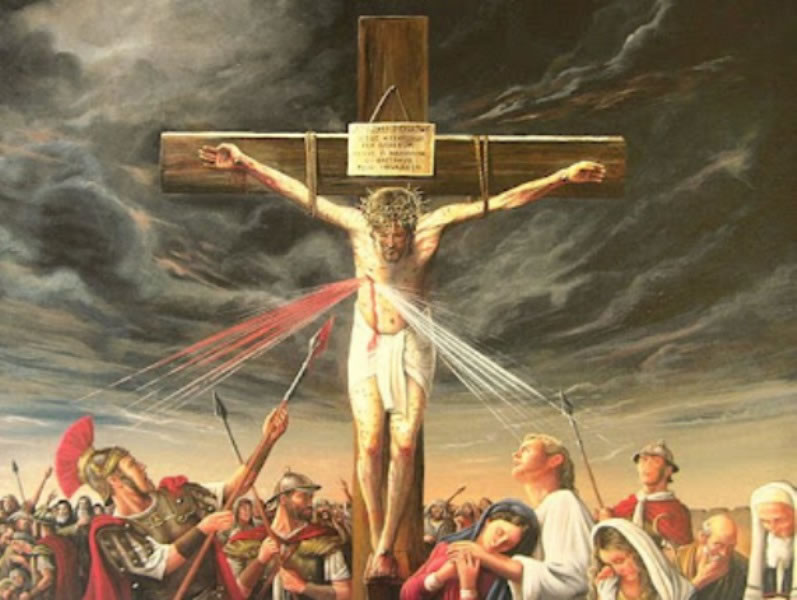
The origin of the spear is associated with one of the most dramatic moments in Christian tradition: the crucifixion of Jesus Christ. The episode is mentioned in the Gospel of John, chapter 19, when a Roman soldier pierces the side of Jesus with a spear to confirm that he was dead.
The biblical text describes that when he was struck, “immediately blood and water came out,” a detail that later gained numerous theological interpretations. For many Christian theologians, this gesture symbolized the birth of the Church, represented by blood and water — elements associated with the sacraments.
Curiously, the Gospel does not mention the soldier’s name. The figure known as Longinus appears only in later traditions of the Church, particularly in apocryphal writings and medieval narratives.
According to these traditions, Longinus was a Roman centurion who, after witnessing the death of Christ, converted to Christianity and was later venerated as a saint in certain Christian traditions, especially in the East.
At this early stage of the story, however, the spear holds no special status. In the biblical account, it is simply a common military weapon — one of thousands used by Roman troops.
The sacralization of the object would come centuries later.
The transformation into a sacred relic
During the first centuries of Christianity, many relics associated with the life of Jesus began to be sought, preserved, and venerated. This phenomenon intensified particularly after the 4th century, when Christianity ceased to be persecuted in the Roman Empire and began to occupy a central position in the religious and political life of the Mediterranean world.
It was in this context that objects connected to the Passion of Christ — such as fragments of the cross, the crown of thorns, and the nails of the crucifixion — began to acquire enormous symbolic importance.
The spear associated with the episode described in the Gospel of John entered this same universe of relics.
Relics were not merely religious objects. They possessed political power. Cities that housed important relics became destinations for pilgrimage, accumulated wealth and prestige, and strengthened their position within Christendom.
To possess a relic meant possessing a fragment of the sacred.
And few fragments could carry more meaning than the weapon that touched the body of Christ.
The discovery in Antioch during the Crusades
One of the most famous episodes involving the Spear of Longinus occurred during the First Crusade at the end of the 11th century.
In 1098, the Crusaders were besieged in the city of Antioch and faced a desperate situation. Surrounded by Muslim forces and suffering from hunger and internal disorder, many believed defeat was inevitable.
At that moment, a peasant named Peter Bartholomew claimed to have received a divine vision revealing the location of the Holy Spear buried beneath the floor of the Cathedral of Antioch.
After excavations carried out inside the church, a spearhead was discovered.
The discovery had an enormous psychological impact among the Crusaders. Believing that God had sent a sign of protection and approval, the Christian armies regained their confidence and launched an unexpected attack against the enemy forces.
Against all expectations, they won the battle.
For many chroniclers of the time, the victory was attributed directly to the presence of the relic.
Even though modern historians question the authenticity of the object found, the episode illustrates something fundamental: the symbolic power of relics could alter the course of historical events.
The spear and the Holy Roman Empire
From the 10th century onward, the Spear of Longinus began to appear associated with the emperors of the Holy Roman Empire.
In this context, it ceased to be merely a religious relic and became part of the so-called “imperial regalia” — ceremonial objects used in the legitimation of imperial authority.
Among these insignia were:
-
the imperial crown
-
the scepter
-
the imperial orb
-
the ceremonial sword
-
and the spear
The spear held a particular place within this set. It represented not only authority but also historical continuity. It was seen as a symbolic link between the Roman Empire, Christianity, and European political power.
The central idea was that the emperor of the Holy Roman Empire was not merely a regional ruler. He was the heir to Roman tradition and the protector of Christendom.
The spear made this narrative visible.
Charlemagne and the myth of the invincible spear
Although historians debate the historical accuracy of this association, medieval tradition later claimed that Charlemagne possessed the Holy Spear.
According to this narrative, the emperor carried the spear during military campaigns and believed it guaranteed victory in battle.
Modern historians consider it likely that this connection was constructed later as part of the formation of the imperial myth surrounding Charlemagne.
Even so, the symbolism was powerful.
Charlemagne was already seen as a ruler chosen by God to restore Christian order in Europe after the collapse of the Western Roman Empire. Associating him with the spear reinforced this image of providential destiny.
Thus, the relic became embedded in the European political imagination as an object that pointed to who was destined to rule.
How many spears exist?
Over the centuries, different relics have claimed to be the true Spear of Longinus.
Among the most well-known are:
The Vienna spear
Currently preserved in the Imperial Treasury at the Hofburg Palace in Austria, it is perhaps the most famous relic associated with the imperial tradition of the Holy Roman Empire.
The Vatican spear
Kept in St. Peter’s Basilica, it is presented as part of the Christian tradition connected to the crucifixion.
The spear of Echmiadzin (Armenia)
Preserved in the museum of the Echmiadzin Cathedral, it is venerated by the Armenian Apostolic Church.
The spear of Kraków
Associated with Polish tradition, although generally considered a ceremonial replica.
The spear of Antioch
Linked to the episode of the Crusades.
The existence of multiple spears did not weaken the symbolic impact of the relic. On the contrary: each version helped perpetuate the narrative that the spear appeared at decisive moments in history.
The twentieth century and the fascination of Nazism
In the 20th century, the Spear of Longinus once again occupied a disturbing place in political imagination.
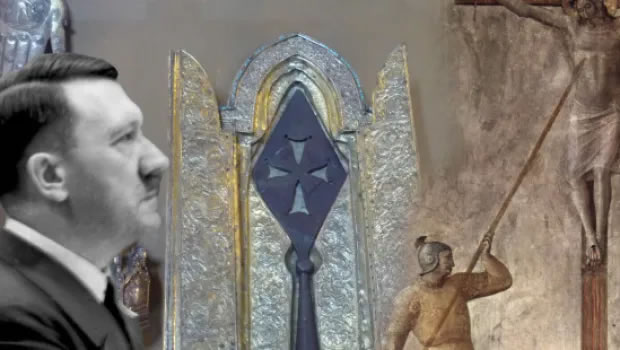
During the Nazi regime, the spear preserved in Vienna became an object of interest within the broader set of historical symbols valued by the Third Reich.
Adolf Hitler was fascinated by relics that represented historical continuity between the Roman Empire, the Holy Roman Empire, and modern Germany.
After the annexation of Austria in 1938 — known as the Anschluss — the spear was transferred to Nuremberg, a city the Nazis considered the symbolic center of the Reich.
Although many popular narratives exaggerate Hitler’s personal obsession with the spear, the fact that it was incorporated into the symbolic imagery of the regime once again reveals how historical objects can be used to reinforce political projects.
For ideologies that present themselves as inevitable or destined to dominate the world, historical symbols function as instruments of legitimization.
The psychological role of objects of power
More than its historical authenticity, the true strength of the Spear of Longinus lies in the meaning people have attributed to it.
Symbolic objects play a profound role in the construction of political authority.
They create narratives.
A crown does not rule a kingdom. A scepter does not command an army. Yet such objects help convince both rulers and subjects that political order possesses an almost sacred foundation.
The spear represents an extreme case of this phenomenon.
It connects three powerful dimensions of human experience:
-
religion
-
war
-
political authority
This combination produces an exceptionally durable symbol.
The spear in popular culture and occultism
In the 20th and 21st centuries, the Spear of Longinus has become a recurring element in popular culture.
It appears in:
-
historical novels
-
adventure films
-
comic books
-
video games
-
conspiracy theories
In many of these narratives, the spear is portrayed as an artifact capable of granting absolute power to whoever possesses it.
This imaginary has been fueled by works of fiction and by esoteric interpretations of history.
Some authors of the 20th century associated the spear with occult traditions, secret societies, and supposed ancient knowledge about spiritual power.
Although these interpretations lack solid historical basis, they have helped reinforce the fascination surrounding the relic.
The spear thus became not merely a historical object, but a cultural symbol that crosses multiple forms of narrative.
What history actually reveals
From a strictly historical perspective, it is extremely difficult — perhaps impossible — to determine which of the existing relics could correspond to the spear mentioned in the Gospel of John.
Weapons of this type were common in the Roman army. Thousands were produced.
Even if the original spear had been preserved, proving its authenticity after two millennia would be extraordinarily difficult.
Yet this uncertainty does not diminish the historical importance of the relic.
On the contrary.
It reveals something deeper about how societies construct meaning around objects.
Relics function as meeting points between faith, memory, and power.
When symbols become instruments of power
The Spear of Longinus may never be identified with certainty.
Perhaps none of the surviving relics is the original.
Perhaps all of them are merely ancient weapons wrapped in narrative.
But that matters little when we seek to understand its historical impact.
What the story of the spear reveals is something more profound and unsettling: symbols can shape the way societies interpret power.
When rulers believe their authority originates from divine will or from an inevitable historical destiny, political limits begin to weaken.
The spear did not create empires.
But it helped men believe they had the right — and sometimes the duty — to create them.
And throughout history, few beliefs have proven as dangerous as the idea that power is inevitable.