

The Physics Behind the Illusion of Contact
Since childhood, we are taught something that seems unquestionably true: we touch things. We touch the ground when we walk, a table when we rest our hand on it, another person in an embrace. Touch feels immediate, intimate, undeniable. It is one of the most direct experiences we have of reality.
And yet, modern physics tells us something astonishing:
You have never actually touched anything.
Not once. Not ever.
No part of your body has truly made contact with another object in the way we intuitively imagine. What we call “touch” is an extraordinarily convincing illusion — the result of invisible forces operating at microscopic scales.
To understand this, we need to rethink three deeply ingrained assumptions: what matter is, what solidity means, and what contact really involves.
Matter Is Not Solid
Everything around you — your body, your chair, the air, the planet itself — is made of atoms. For a long time, atoms were pictured as tiny solid spheres, like miniature billiard balls. That image is useful for teaching, but fundamentally wrong.
An atom consists of:
-
A tiny nucleus made of protons and neutrons
-
A surrounding cloud of electrons
The scale difference is staggering. If the nucleus were the size of a soccer ball, the atom would be roughly the size of a stadium. Nearly all of it is empty space.
The “solid” world is mostly emptiness.
But that emptiness is not nothing. It is structured emptiness — filled with fields.
The Universe Is Made of Fields, Not Little Solid Particles
In modern physics, especially quantum field theory, particles are not tiny solid objects. They are excitations — vibrations — in underlying fields that exist everywhere.
An electron is not a little sphere.
It is a localized excitation of the electron field.
A photon is not a tiny particle of light flying through space.
It is a vibration in the electromagnetic field.
Matter is not made of solid chunks. It is made of stable patterns in interacting fields.
When your hand approaches a table, it is not two solid surfaces meeting. It is fields interacting with fields.
And that interaction prevents contact.

Electrons Do Not Touch — They Repel
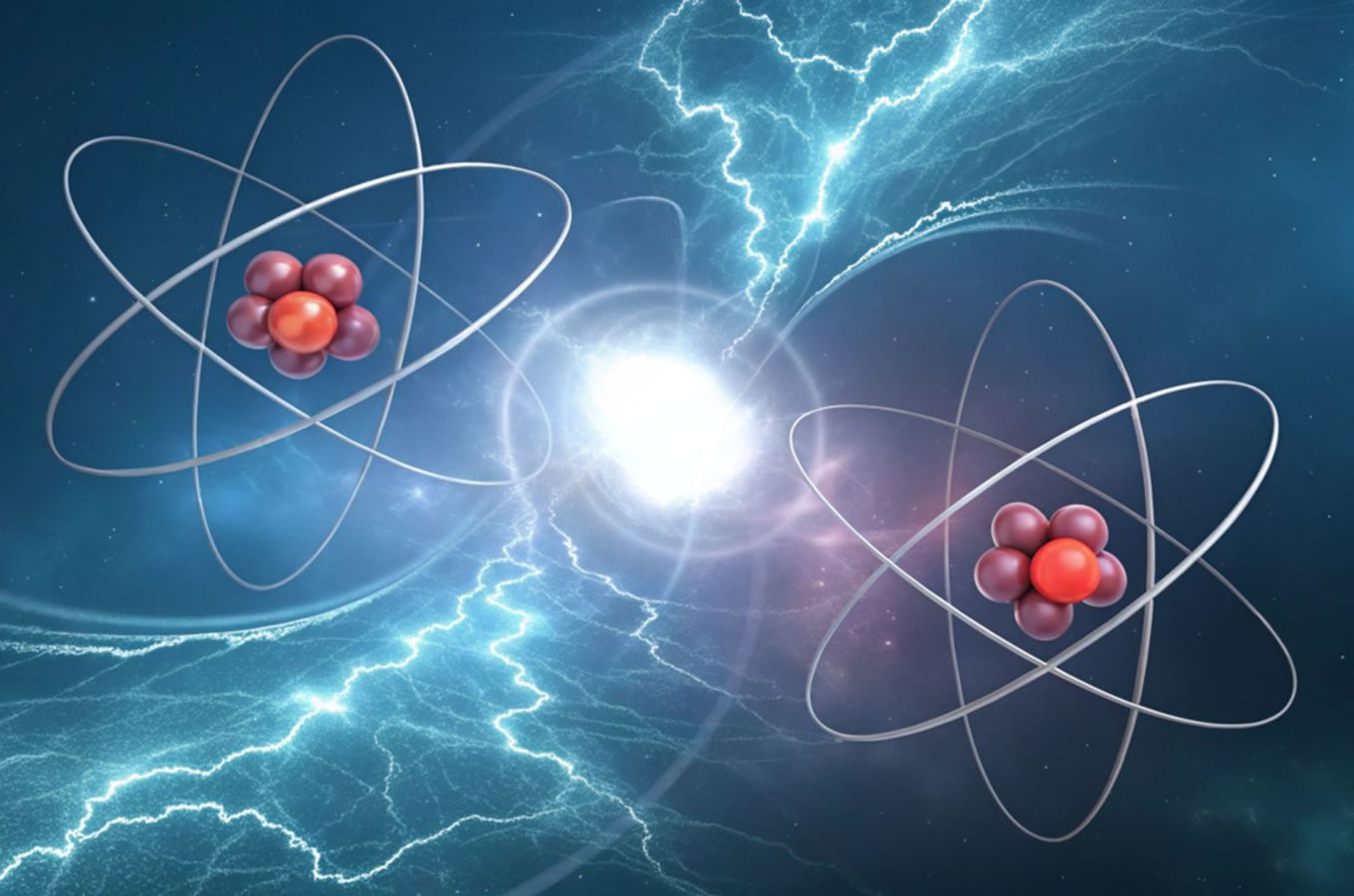
When the atoms in your hand approach the atoms in a table, their electron clouds begin to interact.
Electrons carry negative electric charge. And like charges repel.
But in quantum electrodynamics, this repulsion is described more precisely: it occurs through the exchange of virtual photons — temporary carriers of the electromagnetic force. These virtual particles mediate the interaction between charged particles.
As your hand moves closer to the table:
-
The electron clouds begin to overlap in probability space
-
Electromagnetic repulsion rapidly increases
-
The force grows dramatically as distance decreases
-
The approach is halted before atomic nuclei can ever collide
There is no direct contact between atoms.
There is only an invisible force pushing back.
That resistance is what you experience as solidity.
The Pauli Exclusion Principle: The Rule That Prevents Collapse
Even deeper than electrical repulsion lies a fundamental quantum rule: the Pauli Exclusion Principle.
It states that no two identical fermions — such as electrons — can occupy the same quantum state at the same time.
This is not a guideline. It is a structural feature of reality.
Without it:
-
Electrons would collapse into atomic nuclei
-
Atoms would have no defined size
-
Matter would lose structure
-
The macroscopic world would not exist as we know it
The world is solid not because matter is rigid — but because certain configurations are forbidden.
Solidity is enforced by quantum restrictions.
The Same Principle Holds Up Dead Stars
The Pauli Exclusion Principle does more than stop your hand from passing through a table. It prevents entire stars from collapsing.
In white dwarf stars, electron degeneracy pressure — a direct consequence of the exclusion principle — counteracts gravity. In neutron stars, a similar effect occurs with neutrons.
The same quantum rule that keeps your coffee mug intact also keeps certain stars from imploding.
The everyday and the cosmic obey the same laws.
The Four Fundamental Forces and the Myth of Contact
To fully understand why nothing truly touches, we must consider the four fundamental forces of nature.
Gravity
Gravity holds you to the Earth and governs galaxies. But at the atomic scale, it is incredibly weak. It does not create the sensation of touch.
The Strong Nuclear Force
It binds protons and neutrons inside atomic nuclei. Extremely powerful — but limited to subatomic distances.
The Weak Nuclear Force
Responsible for certain forms of radioactive decay. Essential for stellar processes, irrelevant for touch.
Electromagnetism
This is the key.
Electromagnetism governs:
-
Electron behavior
-
Chemical bonds
-
Material strength
-
Elasticity
-
Friction
-
Texture
-
Electrical signals in your nervous system
Everything you call “touch” is electromagnetism in action.
What You Actually Feel When You “Touch” Something
If no atoms ever truly collide, why does touch feel so real?
Because your nervous system interprets force as contact.
When your hand approaches an object:
-
Electromagnetic repulsion prevents further penetration
-
The outer layers of your skin deform slightly
-
Mechanoreceptors in your skin activate
-
Electrical signals travel to your brain
-
Your brain interprets this as “contact”
You are not feeling matter meeting matter.
You are feeling resistance.
You are feeling force.
You are feeling fields pushing back.
Touch is a neurological interpretation of electromagnetic interaction.
What About Heat and Friction?
Heat is atomic vibration.
When something feels warm, its atoms are vibrating more intensely. That energy transfers via electromagnetic interactions.
Friction is not surfaces “scraping” in a simple mechanical sense. It arises from electromagnetic interactions between microscopic surface irregularities.
Even texture — roughness, smoothness — is governed by electromagnetic forces at atomic scales.
The tactile world is electromagnetism translated into sensation.
The Paradox of Intimacy
There is something philosophically unsettling about this.
When you hug someone, you believe you are in direct contact. When you hold someone’s hand, it feels immediate and physical.
But at the atomic level, a tiny gap always remains.
There is always separation.
The closest possible proximity in the universe is still mediated by force.
Nothing truly merges.
And that separation is precisely what allows identity.
If atoms could occupy the same state freely, objects would lose distinction. Boundaries would dissolve.
Existence depends on resistance.
Being requires separation.
Matter as Relationship, Not Substance
Modern physics suggests a profound shift in perspective.
A table is not a solid “thing” in the classical sense. It is:
-
A stable configuration of quantum fields
-
Maintained by electromagnetic repulsion
-
Structured by probabilistic laws
-
Constrained by quantum prohibitions
Reality is not made of solid objects.
It is made of stable relationships between fields.
The universe is not a collection of things — it is a network of interactions.
Reality as Interface
From an evolutionary standpoint, our senses were not designed to reveal ultimate truth. They evolved to help us survive.
We perceive solidity because it is useful.
We see colors because they are adaptive.
We feel touch because it allows us to interact safely with our environment.
But what we perceive is a biological interface — not a literal depiction of fundamental reality.
Just as a computer screen shows icons instead of electrical currents, our perception shows “objects” instead of interacting quantum fields.
Touch is part of that interface.

What Would True Contact Even Mean?
For two particles to occupy exactly the same position and quantum state would require violating fundamental laws of physics.
Under ordinary conditions, this simply does not happen.
Only under extreme conditions — such as nuclear fusion inside stars — do particles approach interactions governed by different forces at incredibly small scales.
In everyday life, absolute contact is forbidden.
The World That Prevents Touch
You have never touched anything because:
-
Atoms are mostly empty space
-
Electron clouds repel via electromagnetism
-
The Pauli Exclusion Principle forbids identical quantum states
-
All interactions are mediated by fields
Touch is real as an experience.
But it is not real as matter colliding in the way we imagine.
Perhaps the most accurate way to summarize it is this:
Reality is not what we feel.
Reality is what prevents us from touching what we feel.
And yet, the illusion is beautiful.
It is functional.
It is necessary.
It allows stars to exist, objects to hold shape, and you to feel the screen beneath your fingertips as you read these words.
Even though, at the deepest level, you have never truly touched it.