
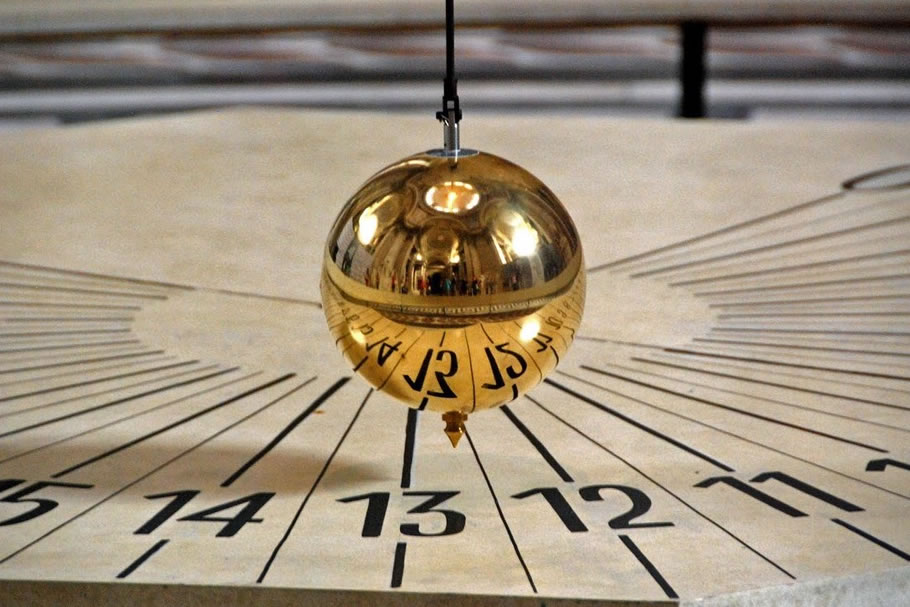
For centuries, the idea that the Earth rotates on its own axis was the subject of debate, resistance, and controversy. Today this seems obvious: our planet completes a rotation every 24 hours, producing the alternation between day and night. However, for a large part of human history, this notion could not be easily demonstrated in a direct and observable way.
It was only in the nineteenth century that an extraordinarily elegant experiment managed to make visible something that had previously been inferred only through astronomical observations and mathematical calculations. This experiment became known as the Foucault pendulum.
Created by the French physicist Léon Foucault in 1851, it showed the public in a clear and observable way that the Earth is constantly rotating. The genius of the experiment lies not in its complexity, but precisely in the opposite: it is an extremely simple system — a weight suspended by a cable — capable of revealing one of the most fundamental motions of our planet.
Since then, the Foucault pendulum has become one of the most famous experiments in physics and continues to be displayed in museums, universities, and historic monuments around the world.
The question that intrigued scientists
The rotation of the Earth had been defended long before Foucault. The heliocentric model proposed by Nicolaus Copernicus in the sixteenth century already placed the Sun at the center of the system and stated that the Earth rotated on its own axis.
Later, scientists such as Galileo Galilei and Johannes Kepler reinforced this model through astronomical observations and mathematical reasoning. Even so, for a long time there was still a lack of a simple demonstration that anyone could observe directly.
Most of the evidence came from the study of stars, planetary movements, or complex mathematical models. For the general public, these demonstrations were far from intuitive.
Was it possible to prove that the Earth rotates without looking at the sky?
That was the question that motivated many scientists in the nineteenth century.
It was in this context that Léon Foucault presented his solution.
The experiment of 1851
In 1851, Foucault carried out a public experiment that would enter the history of science. He installed a large pendulum inside the Panthéon in Paris, a monumental building whose high dome allowed a very long cable to be suspended.
The device consisted essentially of three elements:
a long cable
a heavy metal sphere
a suspension point high in the dome
The cable measured about 67 meters and held a sphere weighing approximately 28 kilograms.
When the pendulum was set in motion, it began swinging back and forth in a straight line. On the floor, Foucault placed small markers that would be knocked down as the pendulum passed over them.
At first, the movement followed exactly the same direction. However, as time passed, something curious began to happen.
The plane of oscillation of the pendulum appeared to rotate slowly.
After some time, the pendulum was no longer passing over the same points on the floor. The direction of the motion had changed.
The explanation for this phenomenon was both simple and profound.
It was not the pendulum that was rotating.
It was the Earth.
The physical principle behind the experiment
The functioning of the Foucault pendulum depends on one of the most fundamental principles of physics: inertia.
According to Newton’s first law, an object in motion tends to maintain a constant trajectory unless an external force alters that motion.
When a pendulum swings, it tends to maintain its plane of motion constant in space. In other words, if it begins swinging in a north–south direction, it will continue swinging in that same direction as long as no lateral force interferes.
However, there is an important detail: the Earth is rotating.
This means that the ground beneath the pendulum is slowly changing position while the pendulum continues moving within the same plane.
For an observer standing on the ground, it appears that the pendulum itself is rotating.
In reality, what is rotating is the planet.
This phenomenon is an example of how physical systems behave differently depending on the frame of reference used for observation.
The role of the Coriolis effect
Another important concept related to the Foucault pendulum is the so-called Coriolis effect.
This effect appears whenever we analyze motion within a rotating system. Because the Earth is a rotating body, movements on its surface can experience small deflections.
The Coriolis effect is responsible for various natural phenomena, including the formation of large wind systems and the rotation of hurricanes.
In the case of the Foucault pendulum, this effect contributes to the gradual change in the apparent direction of the motion.
It is what causes the plane of oscillation to appear to rotate when observed from the Earth’s surface.
The observed rotation speed
An interesting detail of the experiment is that the speed at which the plane of oscillation rotates depends on latitude.
At the poles, the effect is at its maximum.
If a Foucault pendulum were installed exactly at the North Pole or the South Pole, the plane of oscillation would complete a full rotation in 24 hours. This means the pendulum’s motion would rotate 360 degrees over the course of a day.
At the Equator, however, the situation is different.
There, the apparent rotation practically disappears. The pendulum would continue swinging almost always in the same direction.
At intermediate latitudes, such as in Europe or Brazil, the effect exists but is partial.
The rate of rotation depends on the sine of the latitude of the location.
This means that the closer the experiment is to the poles, the more evident the phenomenon becomes.
A visually powerful experiment
One of the reasons the Foucault pendulum became so famous is that it transforms an abstract concept into something visible.
The rotation of the Earth is something we cannot directly perceive in everyday life. The planet is enormous, and its movement is extremely smooth relative to our human scale.
For that reason, in daily life we have the impression that we are standing on completely motionless ground.
The Foucault pendulum breaks this illusion.
It shows that we are actually standing on a gigantic platform that is constantly moving.
By slowly observing the change in the direction of the pendulum, it becomes impossible to ignore the fact that the Earth is rotating.
This demonstration is so elegant that many people consider the Foucault pendulum one of the most beautiful experiments in the history of physics.
Where to see a Foucault pendulum today
Today there are many Foucault pendulums operating in museums and scientific institutions around the world.
They are usually installed in large halls with high ceilings, allowing the use of long cables that keep the pendulum moving for extended periods.
Some of the most famous examples can be found in:
science museums
astronomical observatories
universities
large historic monuments
In many cases, small pins are placed on the floor so that the pendulum gradually knocks them down, visually demonstrating the change in the direction of the motion.
This detail makes the experiment even more didactic.
Even someone unfamiliar with the physics involved can easily perceive that something is happening.
Is it possible to build a Foucault pendulum at home?
Although the large pendulums found in museums are impressive, simplified versions of the experiment can be assembled using common materials.
All that is needed is:
a relatively long string
a weight to serve as the mass
a high point of suspension
The longer the string and the heavier the object, the better the result.
After assembling the pendulum, it can be set in motion along a straight line, and the initial direction can be marked on the floor with chalk or tape.
In the first few minutes, the motion will follow exactly that direction.
However, as time passes, a small deviation may become noticeable.
This deviation occurs because the ground is rotating along with the Earth.
Although the effect is much more subtle in small pendulums, it can still be observed with patience.
Why the length of the cable matters
In large scientific experiments, the pendulum cable may reach dozens of meters in length.
This happens for several reasons.
First, longer pendulums oscillate more slowly, which makes the motion easier to observe.
Second, long pendulums lose energy more slowly, allowing them to keep oscillating for extended periods.
Third, the greater the mass and length of the system, the smaller the influence of small external disturbances such as air currents.
These factors make the experiment far more stable.
This is why museums and scientific institutions prefer installing large-scale pendulums.
An elegant proof of Earth’s rotation
The Foucault pendulum has a characteristic that makes it particularly remarkable.
It demonstrates the rotation of the Earth without relying on astronomical observations.
There is no need to observe stars, planets, or the movement of the Sun.
The experiment also does not require telescopes, complex calculations, or sophisticated instruments.
All it uses is a weight suspended from a cable.
Even so, this simple system manages to reveal one of the fundamental motions of our planet.
This shows how basic principles of physics can reveal enormous phenomena when applied with creativity.
The scientific legacy of Foucault
Léon Foucault became famous not only for the pendulum.
He also performed important measurements of the speed of light and contributed to the development of several scientific instruments.
Nevertheless, it was the pendulum that made him widely known around the world.
His experiment continues to be displayed more than 170 years after its creation.
Few scientific demonstrations have crossed so much time while remaining relevant, elegant, and educational.
The Foucault pendulum stands as a classic example of how science can reveal profound truths with simple tools.
It reminds us that even when everything around us seems still, the entire planet is in motion.
Every second, the Earth rotates silently beneath our feet — and a simple pendulum is capable of proving it.