The Brazilian Molecule That May Revolutionize Spinal Cord Regeneration
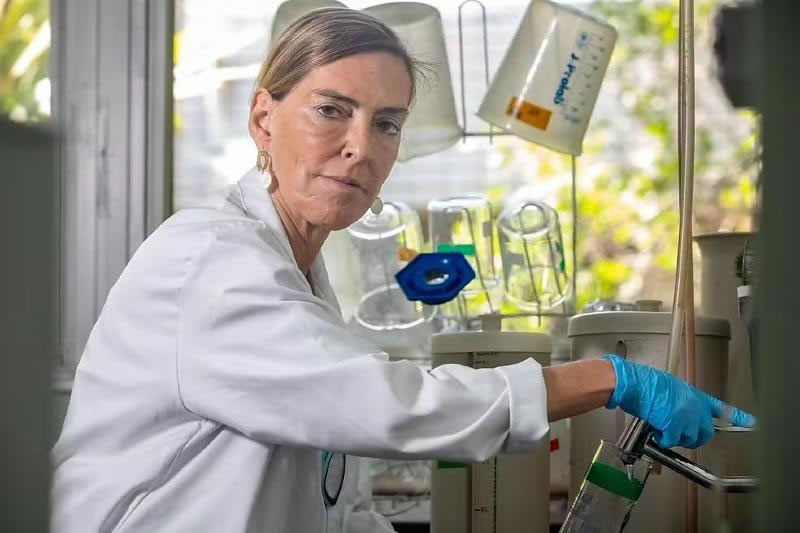
In recent years, a term has begun to circulate widely in Brazilian scientific news: polylaminin. Developed under the leadership of researcher Tatiana Sampaio at the Federal University of Rio de Janeiro (UFRJ), the molecule has been pointed to as one of the most promising advances in Brazilian regenerative medicine.
The growing attention surrounding this discovery is not accidental. Spinal cord injuries are among the most devastating conditions in modern medicine. Unlike many other tissues in the human body, the central nervous system has extremely limited regenerative capacity. For decades, scientists believed that restoring nerve connections after severe spinal injury was nearly impossible.
The proposal behind polylaminin challenges this paradigm.
But after all:
• What exactly is polylaminin?
• How does it work at the cellular level?
• Why are spinal cord injuries so difficult to treat?
• And why has this discovery generated so much enthusiasm among scientists?
In this article, we will explore these questions in depth, using clear language while maintaining the scientific rigor necessary to understand the significance of this research.
1. The problem: why doesn’t the spinal cord regenerate?
To understand the importance of polylaminin, we must begin with the problem it seeks to solve.
The spinal cord is a cylindrical structure of nervous tissue that runs inside the vertebral column and functions as the main communication pathway between the brain and the rest of the body. Through it travel electrical impulses responsible for essential functions such as:
• movement control
• sensory perception
• automatic reflexes
• regulation of internal organs
When a spinal cord injury occurs—caused by car accidents, diving into shallow water, falls, urban violence, or sports trauma—these communication pathways can be interrupted.
The consequences can be severe:
• paraplegia (loss of movement in the legs)
• tetraplegia (paralysis of all four limbs)
• loss of sensation
• urinary and intestinal dysfunction
• respiratory complications
• metabolic and cardiovascular problems
Unlike skin or bone, which have strong regenerative capacity, the central nervous system has extremely limited ability to repair itself.
This happens for three main reasons.
First, after a spinal cord injury the body forms what is known as a glial scar. This process involves support cells of the nervous system, called astrocytes, which create a kind of molecular barrier at the injury site. Although this scar initially has a protective role, it ultimately becomes a physical and chemical obstacle to neuronal growth.
Second, the molecular environment of the injured spinal cord becomes hostile to regeneration. Certain molecules actively inhibit axonal growth. Proteins associated with myelin, such as Nogo-A, send signals that essentially tell neurons not to grow in that region.
Third, adult neurons themselves have limited intrinsic regenerative capacity. Unlike during embryonic development—when neurons grow rapidly and establish thousands of connections—the adult nervous system is much more conservative in its ability to rebuild.
In simple terms, after an injury the spinal cord environment becomes biologically hostile to neural growth.
This is the context in which polylaminin emerges as a potentially transformative tool.
2. What is laminin — the inspiration behind polylaminin?
To understand polylaminin, it is necessary to first understand the molecule that inspired it: laminin.
Laminin is a protein found in the extracellular matrix, a complex network of molecules that surrounds and supports the cells of the body. This matrix functions as a kind of molecular scaffold, providing structural support while also sending biochemical signals that guide cellular behavior.
These signals regulate essential processes such as:
• cellular growth
• cell migration
• cellular differentiation
• tissue survival
In the nervous system, laminin plays a particularly important role during embryonic development. It acts as a guide for growing neurons.
When neurons are forming in the embryo, their axons—the projections responsible for transmitting electrical signals—must find the correct path to establish connections with other cells. Laminin helps in this process by creating surfaces that stimulate axonal growth and guide its direction.
In other words, laminin functions like a molecular track that directs neurons toward their destinations.
The scientific idea behind polylaminin emerged from a simple but powerful question:
If laminin helps neurons grow during development, could we recreate this favorable environment after an injury?
3. What is polylaminin?
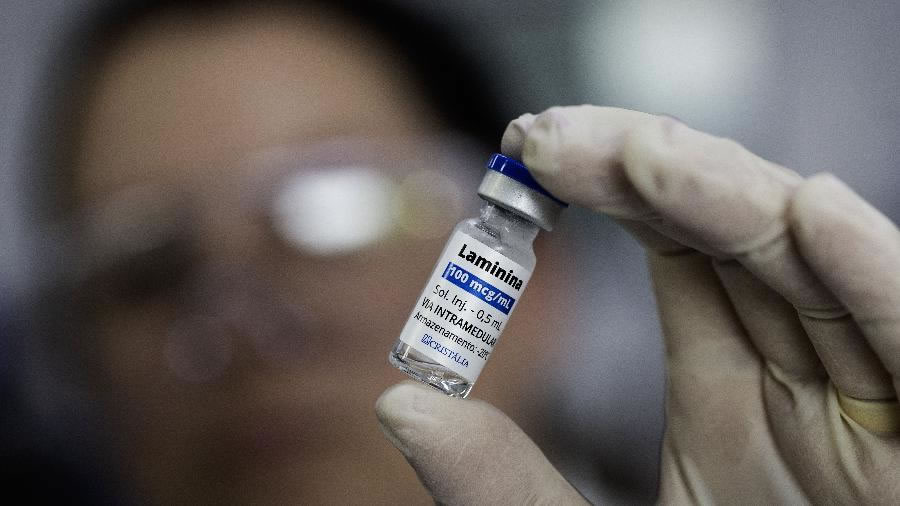
Polylaminin is a synthetic molecule inspired by the structure of natural laminin but designed to amplify its regenerative properties.
Instead of using the natural protein exactly as it appears in the body—which can be unstable or degrade quickly—researchers developed a modified version that organizes multiple laminin units into a more robust molecular structure.
This molecular organization helps promote:
• greater structural stability
• improved interaction with neurons
• prolonged stimulation of axonal growth
Functionally, polylaminin acts as a kind of molecular bridge between healthy regions of the spinal cord separated by an injury.
It provides biochemical signals that encourage neurons to grow across the damaged area and restore interrupted neural connections.
4. How does polylaminin act in the body?
The functioning of polylaminin can be understood in several stages.
Application at the injury site
The molecule is administered directly into the injured region of the spinal cord. This allows it to act precisely where neural pathways have been disrupted.
Modification of the molecular microenvironment
Once present at the injury site, polylaminin interacts with the extracellular matrix and alters the molecular composition of the region.
This process may reduce the influence of inhibitory signals and create a more permissive environment for neuronal growth.
Stimulation of axonal growth
Neurons transmit electrical signals through extensions called axons. When a spinal injury occurs, these axons are often interrupted or destroyed.
Polylaminin stimulates the growth of these projections, encouraging neurons to extend new connections.
This process may involve:
• axonal elongation
• formation of new neural branches
• establishment of new synapses
Reconnection of neural circuits
If axons succeed in crossing the injured area and reconnecting with other neurons, neural circuits can be restored.
This phenomenon is known as functional reconnection.
When this occurs, there is potential for partial or significant recovery of motor and sensory functions.
5. Experimental results and clinical trials
As with any new biomedical therapy, polylaminin had to undergo rigorous testing before reaching clinical studies in humans.
In preclinical laboratory experiments and animal models, researchers observed promising results.
Among them:
• significant axonal growth in the injured region
• improvements in motor parameters in animal models
• partial reconnection of disrupted neural pathways
These results attracted scientific attention and led Brazil’s National Health Surveillance Agency (Anvisa) to authorize the start of controlled clinical trials.
Clinical trials follow strict stages.
In Phase 1, researchers primarily evaluate the safety of the therapy in humans.
In Phase 2, preliminary signals of effectiveness are analyzed.
In Phase 3, the treatment is compared with existing therapies in larger patient groups.
Polylaminin is still in the early stages of this process, which means results must be interpreted cautiously.
Nevertheless, the progression to clinical testing already represents a major milestone for Brazilian biomedical research.
6. Comparison with other therapies under development
Spinal cord regeneration is one of the greatest challenges in modern medicine, and several approaches are being studied around the world.
These include:
• stem cell therapies
• biomaterial implants
• spinal cord electrical stimulation
• genetic engineering approaches to stimulate neural growth
Each of these strategies has advantages and limitations.
Stem cell therapies, for example, have regenerative potential but involve complex procedures and high costs.
Artificial implants may provide physical support for neural growth but do not always reproduce the biochemical signals necessary for proper neuronal guidance.
Polylaminin stands out because it combines molecular simplicity with direct inspiration from natural biological processes.
This may make its production and application more accessible compared to some of the more complex therapies currently under investigation.
7. Global impact: what could change for the world?
Spinal cord injuries affect hundreds of thousands of people every year worldwide.
Beyond the physical consequences, they also carry profound social implications.
Patients often face:
• loss of independence
• permanent need for assistance
• high medical costs
• significant psychological impact
Healthcare systems also face major challenges, since treatment and rehabilitation for spinal cord injury patients can last decades.
If an effective regenerative therapy emerges, the effects could be far-reaching.
Possible impacts include:
• reduction in permanent disabilities
• improved quality of life for patients
• lower long-term healthcare costs
• transformation of neurological rehabilitation
In this context, a technology capable of stimulating neural regeneration would represent a historic shift in medicine.
8. Challenges and scientific caution
Despite the excitement surrounding polylaminin, science requires caution.
Several challenges must be addressed before the therapy can become widely available.
Among them:
• ensuring long-term safety
• preventing uncontrolled cellular growth
• confirming effectiveness across different types of injury
• reproducing results in independent research centers
Replicability is one of the pillars of modern science. A discovery only becomes established when different research groups obtain similar results.
9. Nobel Prize? It’s still too early
Whenever a potentially transformative discovery appears, speculation about the Nobel Prize tends to follow.
Historically, the Nobel Prize in Physiology or Medicine is awarded only after years or even decades of scientific validation.
Even if polylaminin eventually proves revolutionary, international recognition will depend on several factors:
• robust clinical results
• global adoption of the technology
• long-term confirmation of its impact
At this stage, discussing a Nobel Prize remains premature.
However, the fact that such speculation exists already demonstrates the symbolic reach of the research.
10. What it means for Brazilian science
Perhaps the most immediate impact of polylaminin is symbolic.
For decades, Brazil has often been seen primarily as a consumer of biomedical technologies developed elsewhere.
Polylaminin reverses this narrative.
It represents:
• research developed in a public university
• national scientific leadership
• female leadership in science
Moreover, the project demonstrates that Brazilian research centers can actively participate in the frontiers of regenerative medicine.
Advances like this can inspire new investments in science, encourage young researchers, and strengthen international collaborations.
Are we facing a new era?
Polylaminin represents a bold scientific bet: encouraging the body itself to rebuild neural connections once considered permanently lost.
It is still too early to claim that we are witnessing a fully established revolution in medicine.
But it is already possible to say that:
• the scientific hypothesis is biologically grounded
• early results are encouraging
• the potential impact is enormous
If clinical trials confirm its effectiveness on a large scale, polylaminin could redefine what we understand by neural regeneration.
And regardless of the final outcome, the research already fulfills an important role: placing Brazilian science at the center of one of the most challenging medical frontiers of the twenty-first century.