How the High-Precision Weapon Used by the United States Works
In modern conflicts, the difference between a conventional military operation and a surgical strike often lies in the precision of the weapons involved. Among the most important tools in this scenario are the so-called precision-guided gravity bombs, a type of weapon that combines a simple principle of physics — the pull of gravity — with sophisticated navigation and trajectory-correction systems.
Recently, U.S. authorities mentioned the possible use of this type of weapon in military operations against Iran, highlighting its ability to hit targets with remarkable accuracy. But what exactly are gravity bombs, how do they work, and why have they become so important in modern warfare?
What Is a Gravity Bomb
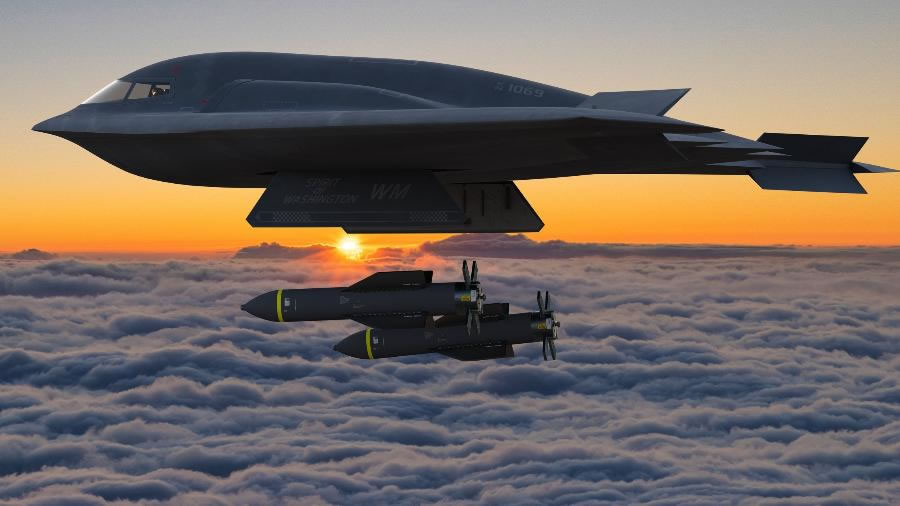
A gravity bomb is, essentially, an aerial weapon that does not have its own propulsion system. Unlike a missile, which uses engines to propel itself toward its target, a gravity bomb is simply released from an aircraft and follows a trajectory determined largely by gravity.
This type of weapon has existed since the early days of military aviation. During the First World War and especially during the Second World War, bomber aircraft dropped bombs that fell freely toward the ground. These weapons were commonly known as free-fall bombs.
The major drawback of this traditional model was low accuracy. Factors such as wind, aircraft speed, altitude, and calculation errors could cause the bomb to land hundreds of meters away from the intended target.
To solve this problem, engineers developed precision-guided gravity bombs, often referred to as guided bombs or smart bombs.
How a Precision-Guided Gravity Bomb Works
The key difference between a conventional bomb and a modern gravity bomb lies in its guidance system.
Although it is still released from an aircraft and depends on gravity to descend, a guided bomb includes mechanisms capable of adjusting its trajectory during its fall.
These systems may include:
-
navigation sensors
-
GPS positioning systems
-
laser guidance
-
movable control surfaces called fins
When the bomb is released, onboard sensors and computers continuously calculate its position relative to the target.
If any deviation occurs, the fins automatically adjust, altering the bomb’s path while it is falling. This mechanism works similarly to the rudder of an aircraft or boat, allowing small corrections that dramatically improve accuracy.
Thanks to these adjustments, some modern guided bombs can strike targets with a margin of error of only a few meters.
Guidance Systems Used
Several guidance methods are used in modern gravity bombs.
Laser Guidance
In this system, the target is illuminated by an invisible laser beam, projected by a designator installed on an aircraft, drone, or even by troops on the ground.
The bomb contains sensors capable of detecting the reflected laser signal and adjusting its trajectory toward the illuminated point.
This method is extremely precise, but it depends on favorable visual conditions, since heavy rain, dust, or smoke can interfere with the laser signal.
GPS Guidance
Another widely used system is GPS guidance.
In this method, the bomb receives exact target coordinates before or during the launch. An onboard navigation system constantly compares its current position with the programmed coordinates and automatically adjusts its course.
This type of bomb has the advantage of not requiring direct visual contact with the target, making it effective even in poor weather conditions.
Hybrid Systems
Many modern weapons use a combination of technologies, integrating GPS, inertial navigation systems, and laser guidance. This increases reliability and reduces the chances of error.
The Origins of Guided Bombs
Although they may seem like recent innovations, the first attempts to create guided bombs date back to the Second World War.
Nazi Germany developed weapons such as the Fritz X, a radio-guided bomb designed to attack ships. The weapon became famous after sinking the Italian battleship Roma in 1943.
The United States also experimented with similar technologies, although the electronics of the time limited their effectiveness.
It was only decades later, with advances in electronics and computing, that guided bombs became truly reliable.
The Revolution of the Gulf War
A major technological turning point occurred during the Gulf War in 1991.
During this conflict, the United States used laser-guided and GPS-guided bombs on a large scale for the first time. Images of extremely precise strikes drew global attention and changed how modern wars were conducted.
From that moment on, military doctrine increasingly emphasized precision strikes, capable of destroying specific targets with reduced collateral damage.
The Concept of Surgical Strikes
Precision-guided gravity bombs are part of what military strategists call surgical strikes.
This concept aims to hit strategic targets — such as military facilities, command centers, or weapons depots — while minimizing the impact on civilian areas.
In practice, this approach allows militaries to:
-
reduce collateral damage
-
minimize civilian casualties
-
increase operational efficiency
-
reduce the amount of ammunition required
A single guided bomb can sometimes replace several conventional bombs that would otherwise be needed to achieve the same effect.
Types of Modern Gravity Bombs
Today, several variations of guided gravity bombs are in use.
Among the best known are:
JDAM (Joint Direct Attack Munition)
A kit developed by the United States that converts conventional bombs into GPS-guided weapons.
Paveway
A family of laser-guided bombs widely used by the U.S. Air Force and allied militaries.
GBU-39 Small Diameter Bomb
A smaller bomb designed for highly precise attacks and capable of penetrating fortified structures.
These systems can be deployed by various types of aircraft, including fighter jets, bombers, and drones.
Why These Weapons Matter in Modern Warfare
In contemporary conflicts, the ability to strike targets with precision has become a decisive strategic factor.
Guided bombs make it possible to:
-
destroy strategic targets quickly
-
avoid wasting ammunition
-
reduce aircraft exposure to enemy fire
-
increase psychological pressure on adversaries
Precise strikes can rapidly weaken critical infrastructure, including military bases, radar systems, and command centers.
The Current Situation in the Middle East
The recent mention of guided gravity bombs occurred amid rising tensions involving the United States, Israel, and Iran.
American officials stated that new military operations may rely on high-precision weapons to strike strategic targets.
According to General Dan Caine, chairman of the Joint Chiefs of Staff, the use of these bombs would allow forces to maintain constant pressure on the adversary while increasing operational effectiveness.
The conflict in the region involves multiple actors and complex alliances. In addition to direct confrontation between Israel and Iranian-backed forces, groups such as Hezbollah have also participated in hostilities.
Recent strikes have targeted strategic areas, including locations near Iran’s capital, Tehran, while Iranian-aligned forces have also launched attacks against Israel.
The Evolution of Technological Warfare
The development of guided bombs is only one example of a broader transformation in military technology.
Over the past decades, armed conflicts have increasingly incorporated:
-
armed drones
-
artificial intelligence
-
surveillance satellites
-
precision weapons
-
cyber warfare systems
These advances have led analysts to argue that modern warfare is becoming more technological and less dependent on large troop deployments.
However, experts also warn that despite the precision of new weapons, conflicts still pose significant risks to civilian populations and regional stability.
Precision Does Not Mean Absence of Impact
Although smart bombs are designed to reduce collateral damage, they are still extremely destructive weapons.
Even highly precise strikes can produce indirect consequences, especially when they occur in urban areas or near sensitive infrastructure.
For this reason, the use of such weapons frequently sparks political and ethical debates about the limits of modern warfare.
The Future of Guided Bombs
The trend for the coming years is that these technologies will continue to evolve.
Military researchers are already developing systems that combine:
-
artificial intelligence
-
automatic target recognition
-
autonomous navigation
-
integration with sensor and satellite networks
These innovations could make weapons even more precise and capable of operating in complex environments.
At the same time, new challenges emerge, including the need to regulate increasingly sophisticated technologies that carry significant destructive potential.