Since ancient times, gold has captivated humanity. Brilliant, rare, and remarkably durable, it has endured for millennia as a symbol of wealth, power, and permanence. Yet there is a silent partner in this story that few truly understand: mercury. A liquid metal, mysterious and almost hypnotic, capable of “capturing” gold — while also carrying a dangerous side.
The relationship between gold and mercury helped build empires, transformed mining techniques, and continues to be used in parts of the world today. At the same time, it has left deep environmental and human consequences. Understanding this connection opens a window into chemistry, history, and the choices that have shaped entire societies.
Let’s explore it.
The metal that seems alive
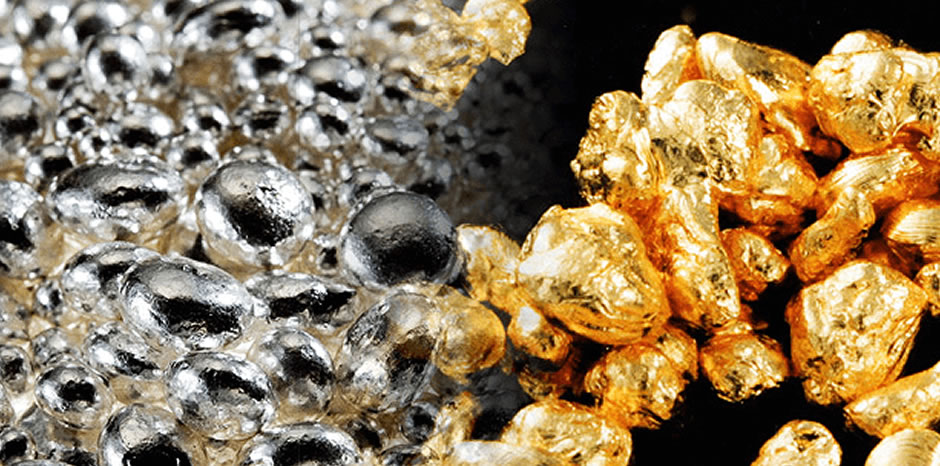
Mercury is one of the most unusual elements in nature. Unlike most metals, it is liquid at room temperature. Its appearance is almost otherworldly: silvery, reflective, and fluid like water — but far denser.
If you have ever seen mercury outside a container, one detail stands out immediately: it does not wet surfaces like water does. Instead, it forms small, rounded droplets that merge and separate with ease, as if they were living metallic beads.
This behavior is due to a property known as high surface tension. Mercury prefers to stick to itself rather than spread out.
But what truly makes mercury remarkable is its ability to interact with other metals — especially gold.
When gold seems to vanish
When mercury comes into contact with gold, something surprising happens: the gold appears to disappear.
In reality, it does not vanish. It mixes with mercury, forming an amalgam — a metallic alloy. Unlike a typical chemical reaction, this process resembles a kind of metallic dissolution.
Gold, which is normally extremely resistant to reactions, becomes “absorbed” by mercury. Its atoms disperse within the liquid, creating a uniform mixture.
It is a counterintuitive phenomenon: one of the most noble metals in nature being effectively “swallowed” by another.
This property became one of the most important discoveries in early mining.
A discovery that transformed mining
There is no single recorded moment when amalgamation was discovered, but evidence shows that ancient civilizations — including the Chinese, Romans, and Arab scholars — were already using mercury thousands of years ago.
The discovery was likely accidental. Imagine someone handling mercury (which was already known in antiquity) and noticing that small particles of gold adhered to it. From there, experimentation would naturally follow.
And it worked remarkably well.
Mercury made it possible to capture fine gold — tiny particles that would otherwise be impossible to recover using simple washing or panning methods. This was a breakthrough.
How gold was extracted
Before modern technologies, gold was obtained mainly through two primary methods:
1. River panning
This is the classic technique, often portrayed in films and illustrations.
Gold is much denser than most surrounding materials. When river sediments are washed in a pan, lighter sand is carried away, and gold settles at the bottom.
This method is still used today, especially on a small scale.
2. Hard rock mining
Gold is also found embedded in rock, often associated with quartz.
In this case, the process involved:
- breaking the rock
- crushing it into smaller pieces
- washing and separating the material
It was far more labor-intensive but allowed access to larger deposits.
3. The role of mercury
This is where mercury became essential.
When mercury was mixed with crushed material, it captured the gold by forming an amalgam. Then, by heating the mixture, the two could be separated.
The gold remained. The mercury evaporated.
Simple, effective… and dangerous.
The critical moment: heating
When an amalgam is heated, mercury transitions from a liquid to a gaseous state. It does not transform into another compound — it remains mercury, now as vapor.
This vapor is invisible, difficult to detect by smell, and extremely toxic.
Historically, this process was carried out without any protective measures. Miners and workers inhaled the vapor directly, often unaware of the risks.
Today, we understand that this is the most dangerous form of mercury exposure.
The hidden cost
Mercury has a dark side.
It is a heavy metal capable of severely affecting the nervous system. Long-term exposure can lead to tremors, memory loss, behavioral changes, and irreversible brain damage.
One of the most serious issues is that mercury does not easily disappear from the environment. It can contaminate rivers, accumulate in fish, and enter the food chain.
This means its impact extends far beyond the site where it is used.
In some parts of the world — particularly in areas with illegal or unregulated mining — this problem remains very real.
Where mercury comes from
Unlike gold, which can be found in its native (pure) form, mercury is typically found in nature as a mineral called Cinnabar.
This mineral has a striking appearance: a vivid, intense red.
To extract mercury, cinnabar is heated. The mercury vaporizes and is then cooled, returning to its liquid form. This relatively simple process has been known for thousands of years.
Interestingly, this same principle is used in reverse to recover mercury after gold separation.
Gold in nature: more than just nuggets
There is a popular image of gold as large, gleaming nuggets — like those seen in cartoons. And yes, such nuggets do exist.
The largest ever discovered was the Welcome Stranger, found in Australia in the 19th century, weighing around 72 kilograms.
But this is not the most common form.
Gold appears in nature in three main ways:
Gold dust
Tiny particles mixed with river sand. This is the most common form in placer deposits.
Nuggets
Larger, irregular pieces — rare, but highly valuable.
Veins in rock
Deposits embedded within rock formations, requiring mining to extract.
The fact that gold exists in a pure state is one of the reasons for its value. It does not react easily with other elements, allowing it to remain intact for millions of years.
Lesser-known curiosities
Gold is nearly eternal
It does not rust, corrode, or degrade easily. A gold object can survive for thousands of years with minimal change.
Mercury was once used in medicine
For centuries, mercury compounds were used to treat illnesses — often with harmful consequences. Today, we know how dangerous this practice was.
The “mad hatter” connection
In the 19th century, hat makers used mercury in the felting process. Many developed neurological disorders, giving rise to the phrase “mad as a hatter.”
Gold exists even in seawater
There is gold dissolved in the oceans — but in such tiny concentrations that extraction is not economically viable.
Mercury forms alloys with many metals
Gold is not unique in this respect. Mercury can also form amalgams with silver, copper, and other metals.
A relationship that shaped history
The interaction between gold and mercury is a powerful example of how chemistry can influence the real world.
It enabled advances in mining, made large-scale gold extraction possible, and helped drive entire economies. At the same time, it introduced environmental and health consequences that are still felt today.
Modern science continues to search for safer alternatives to mercury. Yet amalgamation persists in many places, largely because it is inexpensive and accessible.
Between fascination and responsibility
Gold and mercury represent two fascinating extremes:
- One symbolizes wealth, stability, and permanence
- The other represents volatility, danger, and hidden risk
Their union is powerful — capable of both creation and destruction.
Understanding this relationship is not just a matter of scientific curiosity. It is also an opportunity to reflect on how we use natural resources and the consequences of those choices.
In the end, the story of gold is not only about wealth. It is about responsibility.