The Garima Gospels, faith, parchment, and the mystery of the day that never ended
There is a kind of silence that is not empty.
It does not represent absence — but accumulated presence. A heavy silence, saturated with history, with aged organic matter, with ink that was once liquid and is now memory. This silence lives in very old places, where time did not merely pass… it settled.
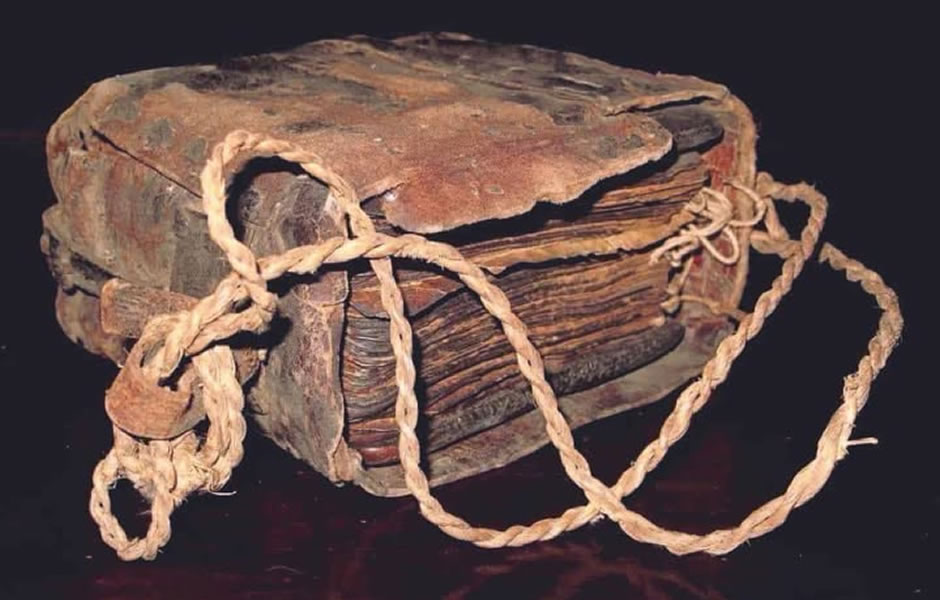
In northern Ethiopia, in an arid and isolated region, far from urban centers and distant from the accelerated flow of modern life, there is one of these places. And within it rests one of the most fascinating objects ever produced by humanity: the Garima Gospels.
More than a book.
More than a manuscript.
A meeting point between faith, art, language, and permanence.
A book made of skin, ink, and endurance
Before paper dominated the world, recording ideas was a physical — almost brutal — process.
Books were not printed. They were constructed.
The Garima Gospels were produced on parchment, a material made from the skin of animals such as goats or sheep. But contrary to what it may seem at first glance, parchment was not merely an improvised surface. It was an advanced preservation technology for its time.
Its resistance to humidity, heat, and natural deterioration is significantly superior to that of papyrus and early paper. It is, in large part, thanks to this technical choice that these manuscripts have survived for more than 1,400 years.
Each page was prepared manually.
Each line was written by hand.
Each mistake required a delicate process of scraping, polishing, and rewriting.
Producing a codex like this was not just work — it was a commitment of years. A continuous effort that demanded discipline, knowledge, and above all, purpose.
And all of it was written in Ge’ez, a language no longer spoken in daily life, but still alive in the liturgy of the Ethiopian Orthodox Church — a language that, like the manuscript itself, has crossed time sustained by tradition.
What exactly are the Garima Gospels?
Although they are often described as “the oldest Bible in the world,” this claim requires precision.
The Garima Gospels are not a complete Bible.
They contain the four canonical Gospels:
- Matthew
- Mark
- Luke
- John
But what makes them extraordinary is not only the content — it is the way this content has reached us.
Radiocarbon tests performed on different pages indicate that the manuscripts were produced between the 5th and 6th centuries AD, approximately between 390 and 570 AD.
This places them among:
- One of the oldest complete Christian codices still in existence
- One of the oldest illustrated manuscripts of Christianity
- One of the rare examples preserved with structural, artistic, and textual integrity
While many ancient documents have survived only in fragments, the Garima Gospels have endured as complete books.
And that changes everything.
Art that defied time
If the text is already impressive, the artwork is almost unsettling.
The manuscripts are richly decorated with illuminations — hand-made illustrations that combine symbolic, geometric, and figurative elements. Among them are:
- Stylized portraits of the evangelists
- Complex geometric frames
- Patterns that merge African and Byzantine influences
- Visual elements from early Christianity
But what is most surprising is not their existence.
It is their condition.
The colors are still alive.
Deep reds, vibrant yellows, and intense blues remain visible after more than a millennium. These pigments were made from minerals and natural elements, prepared through artisanal techniques that, in many cases, are still not fully understood.
It is as if time chose to ignore that book.
Or at least… respect it.
The monastery that never let the book disappear
Unlike many ancient manuscripts that were rediscovered after centuries of abandonment, the Garima Gospels were never truly “lost.”
They have always been where they are.
Preserved in the monastery associated with Abba Garima, in the Tigray region.
Throughout history, countless manuscripts disappeared due to wars, looting, fires, or religious transformations. But the Garima Gospels remained protected within a continuous monastic tradition.
They were not treated as archaeological artifacts.
They were treated as living objects.
Read, preserved, revered.
The academic world came later.
The legend of the day that never ended
And here we reach the point where history and myth meet.
According to Ethiopian oral tradition, Abba Garima was tasked with copying the Gospels alone.
Up to this point, nothing unusual.
But the story continues.
It is said that he had to complete the work in a single day. As time passed, it became clear that this would be impossible. The sun began to set… and the manuscript was still unfinished.
Then something extraordinary happened.
The sunset was delayed.
The day was extended.
Light remained in the sky until the sacred work was completed.
Only then did time resume its course.
From a historical perspective, there is no evidence that this occurred. Paleographic analysis indicates that the manuscripts were produced by multiple hands and over a significant period of time.
And yet, the legend endures.
And perhaps it tells us more about the nature of faith than about the chronology of events.
The Ethiopian Bible and its unique texts
Another element that deepens the fascination with these manuscripts is the broader Ethiopian tradition.
The Ethiopian Orthodox Church possesses one of the most extensive biblical canons in Christianity.
By comparison:
- Protestant Bible → 66 books
- Catholic Bible → 73 books
- Orthodox traditions → around 81 books
- Ethiopian tradition → up to 84 books
Among the additional texts preserved are:
- The Book of Enoch
- The Book of Jubilees
- 1, 2, and 3 Meqabyan
- Other writings preserved exclusively in Ethiopian tradition
This does not mean that other traditions “removed” these texts, but rather that different canons were defined over time.
Ethiopia, due to its geographical position and cultural continuity, preserved very ancient textual traditions that disappeared elsewhere.
Are they the oldest Bible in the world?
The short answer: no.
Biblical fragments exist from as early as the 2nd century. Other complete codices, such as the Codex Sinaiticus, are also extremely ancient and even earlier.
But the Garima Gospels occupy a unique position.
They are:
- Complete codices, not fragments
- Richly illustrated
- Preserved with original binding
- Maintained in continuous liturgical use
- Culturally intact within their original tradition
They are not the oldest in absolute terms.
But they are, without a doubt, one of the most extraordinary examples of textual survival in human history.
Where history and myth are no longer opposites
Perhaps the greatest fascination of the Garima Gospels does not lie in their age, nor in their art, nor even in their rarity.
But in the intersection.
Between:
- Manuscript and relic
- History and tradition
- Technique and spirituality
- Time and permanence
Because even if the sun did not stop…
For that book, in a certain way, time truly slowed down.
The pages are still there.
The ink is still alive.
The language is still being recited.
The faith that produced it is still practiced.
The weight of a book that is more than a book
In a world where digital files can disappear in a matter of years — or even days — there is something profoundly unsettling about a physical object surviving for more than 1,400 years.
The Garima Gospels are not just a religious artifact.
They are:
- A historical document of incalculable value
- A work of ancient art
- A rare linguistic record
- A symbol of African Christian tradition
- And, for many, a material expression of faith
Between scientific analysis and spiritual narratives, they remain exactly where they have always been.
Guarded not only by stone walls…
But by generations who believed that some words were simply too sacred to be lost to time.
And perhaps they were right.