When the Mind Creates an Invisible Companion to Survive
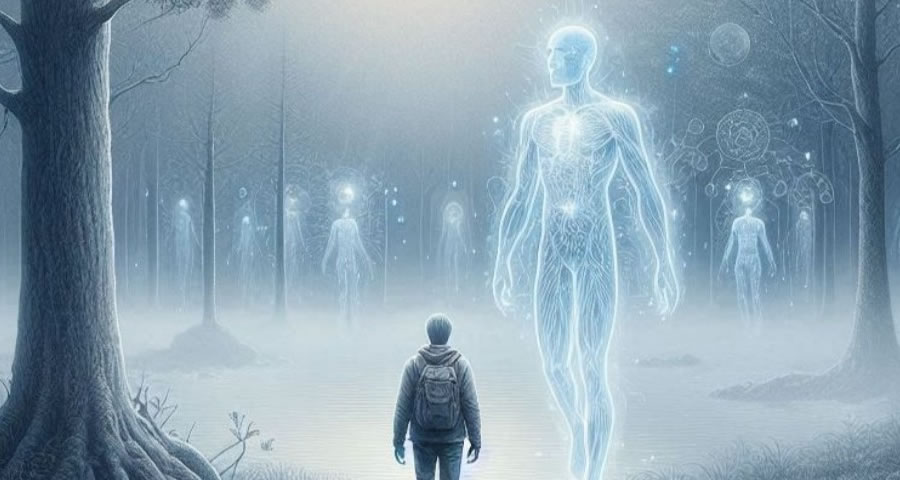
In the absolute silence of a snow-covered mountain, when the wind cuts through the skin and the body no longer responds with the same strength, some survivors report something that defies logic: the clear sensation that they are not alone.
There are no extra footprints in the snow. There is no audible voice in the environment. And yet, someone is there.
Someone who walks beside them.
Who guides.
Who encourages.
Who saves.
This intriguing phenomenon became known as the Third Man Factor — an experience reported by explorers, mountaineers, shipwreck survivors, and people who endured extreme situations throughout history.
But after all… is this an illusion? A function of the brain? Or something deeper?
The origin of the phenomenon: a presence in the ice
The term gained notoriety through the British explorer Ernest Shackleton, during one of the most dramatic survival stories ever recorded.
After the ship Endurance was destroyed by Antarctic ice, Shackleton and his crew were stranded in one of the harshest environments on Earth. In one of the most critical stages of the journey, he and two companions crossed South Georgia Island under extreme conditions: intense cold, exhaustion, hunger, and constant risk of death.
Later, when recounting the experience, all three agreed on something unsettling:
they had the clear sensation that there was a fourth person walking alongside them.
This presence did not speak directly, was not clearly seen, but it was there — constant, silent, and, above all, comforting.
A name inspired by literature
The concept was later named the “Third Man Factor,” inspired by a line from The Waste Land, a poem by T. S. Eliot:
“Who is the third who walks always beside you?”
Interestingly, the poem itself was influenced by accounts from explorers, creating a bridge between art, human experience, and psychological mystery.
A pattern that repeats across the world
What makes this phenomenon even more fascinating is that Shackleton’s case is far from unique.
Similar reports appear across different cultures, environments, and time periods — always sharing strikingly similar characteristics.
On the highest mountains on Earth
Climbers in places like Mount Everest frequently report:
-
hearing instructions
-
sensing someone walking beside them
-
perceiving a presence guiding their actions
In many cases, this “invisible companion” appears precisely when the body is already at its limit.
Shipwrecks and survival at sea
People lost at sea or drifting alone have described:
-
a clear inner voice
-
a sense of companionship
-
guidance on where to go or how to endure
Deserts and extreme isolation
Explorers in deserts, soldiers in war zones, and individuals subjected to prolonged isolation have also reported similar experiences.
What does science say about this?
The most accepted explanation today does not involve spirits or external entities, but something equally fascinating:
the human brain itself.
The region that separates “self” and “other”
One of the key areas involved is the temporoparietal junction.
This region is responsible for:
-
body awareness
-
spatial orientation
-
distinguishing between “self” and “others”
Under normal conditions, this system allows you to clearly understand:
-
where your body is
-
what belongs to you
-
what belongs to the environment
But in extreme situations…
this system can fail.
When the brain “duplicates” presence
Under conditions such as:
-
extreme fatigue
-
sleep deprivation
-
intense cold
-
lack of oxygen
-
overwhelming stress
the brain may lose its normal integration of sensory information.
And then something extraordinary happens:
it may project a second presence — as if another person were there.
But this “other person” is actually an extension of the mind itself.
Scientists have recreated the sensation in the lab
Researchers were able to artificially induce this experience.
In an experiment:
-
participants had their backs touched by a device
-
at the same time, they performed the same movement with their hands
-
but there was a slight delay between action and sensation
This mismatch was enough to produce something remarkable:
several participants reported feeling a presence behind them.
Some even claimed there was someone “mimicking their movements.”
The brain as a generator of realities
This experiment reveals something profound:
the sensation of presence does not necessarily depend on another person actually being there.
It can be internally constructed when the brain:
-
loses sensory synchronization
-
misinterprets bodily signals
-
attempts to reorganize perception
A survival mechanism?
Here lies one of the most compelling hypotheses:
the Third Man Factor may be an evolutionary survival mechanism.
Imagine a prehistoric human, injured and alone, on the brink of death.
If the brain creates a presence that says:
“keep going”
“don’t stop”
“this way”
the chances of survival increase.
Why is the presence helpful instead of harmful?
This is a crucial detail.
If it were just a random hallucination, it could generate fear or confusion.
But it doesn’t.
In most reports, the presence is:
-
calm
-
protective
-
guiding
-
encouraging
In other words, it functions as a highly effective internal psychological support system.
The connection with near-death experiences
The phenomenon also appears in reports from people who have experienced:
-
severe accidents
-
cardiac arrest
-
life-threatening situations
These experiences often include:
-
a sense of not being alone
-
a guiding presence
-
an extremely clear inner voice
This raises an important possibility:
the Third Man Factor may be part of the same mechanism behind near-death experiences.
The emergence of the “observing self”
Some philosophers and psychologists propose an even deeper interpretation.
They suggest that the brain operates on two levels of consciousness:
-
the self that lives the experience
-
the self that observes the experience
Under normal conditions, these two are integrated.
But in extreme situations…
they may separate.
And when that happens, the observing self may be perceived as another entity.
Does this explain belief in spirits?
This leads us into fascinating territory.
Many anthropologists and cognitive scientists suggest that phenomena like this may have contributed to:
-
belief in spirits
-
the idea of guardian beings
-
perceptions of divine presence
-
intense religious experiences
If the human brain can generate the sensation of an invisible presence, it may have deeply influenced human culture throughout history.
Spirituality vs. science
Despite scientific explanations, many people interpret the experience in spiritual terms.
Common interpretations include:
-
guardian angels
-
spiritual guides
-
divine protection
-
manifestation of the soul
And here lies an important point:
science explains how the phenomenon occurs, but not necessarily the meaning people assign to it.
A detail that intrigues researchers
There is a consistent pattern across reports:
people do not feel fear.
Instead, they feel:
-
trust
-
safety
-
mental clarity
This is highly unusual for hallucinations, which are often chaotic or distressing.
When the mind saves the body
Perhaps the most powerful interpretation is this:
the human brain, when faced with extreme danger, may activate an extraordinary resource:
it turns consciousness itself into companionship.
As if it were saying:
“If you are alone… I will create someone to help you.”
The boundary between reality and perception
The Third Man Factor forces us to confront an uncomfortable question:
how much of our reality is actually constructed by the brain?
If we can clearly feel a presence that does not exist…
what else might the mind be capable of creating?
A final reflection
Perhaps what is most fascinating about this phenomenon is not the mystery itself, but what it reveals about us.
In moments of extreme despair, when everything seems lost, human beings still carry within themselves an extraordinary capacity:
to create hope.
Even if that hope comes in the form of an invisible presence.
The Third Man Factor is one of the most intriguing phenomena of human experience.
It lies at the intersection of:
-
neuroscience
-
psychology
-
philosophy
-
spirituality
It can be explained as a function of the brain.
It can be interpreted as something deeper.
But one thing is certain:
in some of the most difficult moments in human history, people survived — and many of them believed they were not alone.