Between extraterrestrial myth, science, and the human need to believe
Few episodes in modern history have managed to endure across decades while remaining not only alive—but active—in the collective imagination as much as the so-called Roswell Incident. In an era defined by scientific advancement, technological precision, and an ever-growing ability to explain phenomena once considered inexplicable, it is striking to observe how certain narratives not only persist, but strengthen over time.
Roswell is one of them.
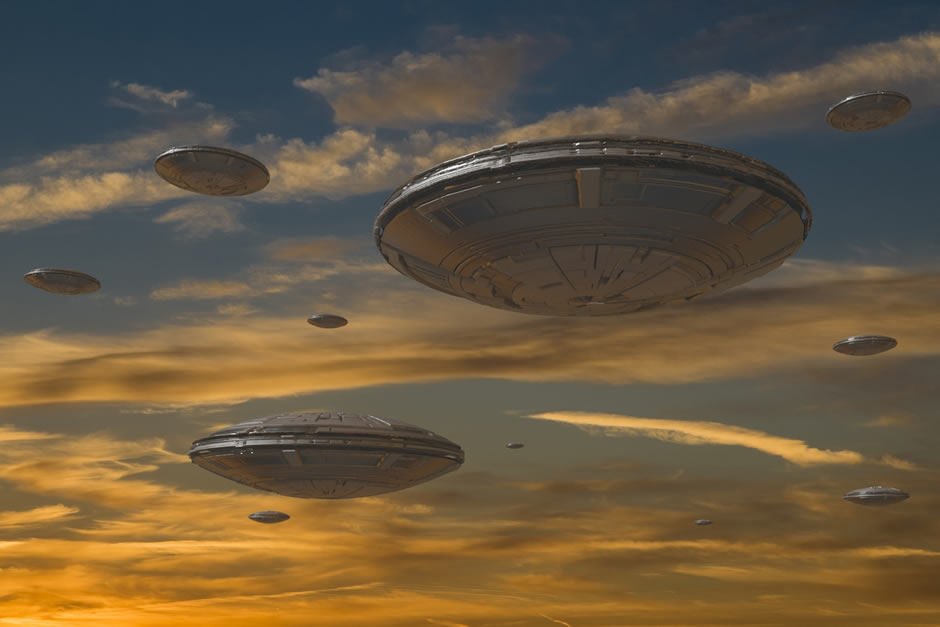
Since 1947, when debris was found in the New Mexico desert and quickly associated, by the public and the media, with the crash of an extraterrestrial spacecraft, the episode ceased to be merely an isolated event. It became a cultural symbol—a point of convergence between science, conspiracy, and imagination. And like every powerful symbol, it began to absorb new elements over the decades.
It is within this already meaning-laden landscape that the so-called Roswell Stone emerges—an apparently simple object that was quickly incorporated into the symbolic universe of one of the most enduring contemporary myths.
Roswell before the stone: the birth of a modern myth
To understand the power of the Roswell Stone, it is necessary to go back in time.
In July 1947, the local newspaper Roswell Daily Record published a headline that would become historic: “RAAF captures flying saucer on ranch in Roswell region.” Hours later, the narrative was revised by military authorities, who stated that the object was nothing more than a weather balloon.
Decades later, official documents would reveal that the debris was part of Project Mogul—a secret United States operation designed to monitor Soviet nuclear tests using high-altitude balloons equipped with sensors.
From a technical standpoint, the explanation is solid.
From a symbolic standpoint, however, it was never enough.
Because Roswell is not only about what happened.
It is about what could have happened.
And that distinction—between fact and possibility—is what keeps the case alive to this day.
The 2004 discovery: when the past meets the present
In September 2004, nearly six decades after the original event, a new chapter begins.
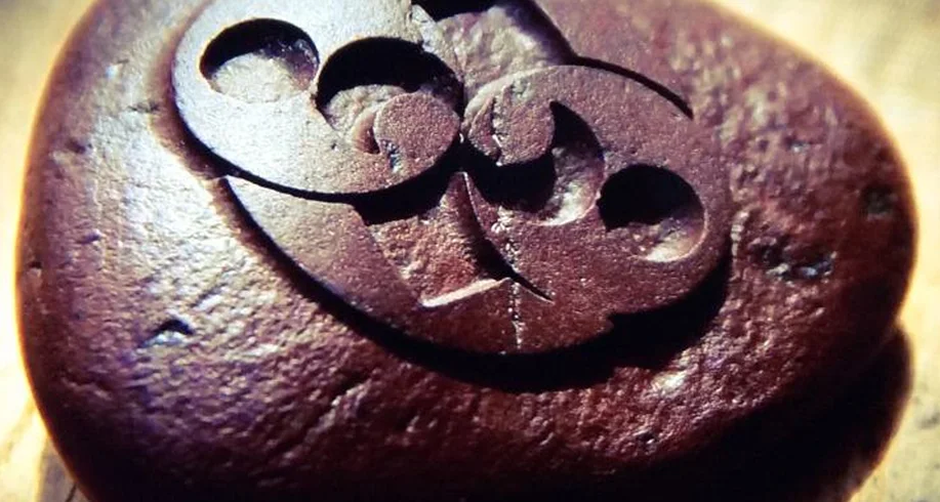
According to widely circulated accounts, businessman Robert Ridge discovered an unusual stone while hunting deer in a desert area of New Mexico. What transformed this find into something extraordinary was not only the object itself, but its location: approximately 18 kilometers from the alleged crash site of the “flying saucer.”
The stone displayed three main characteristics:
- A relatively regular triangular shape
- A smooth, unusual surface
- Geometric inscriptions engraved upon it
These inscriptions—perhaps the most intriguing element—were interpreted by many as astronomical symbols: representations of suns, moons, or celestial alignments.
From that moment on, the object ceased to be a curiosity and became a hypothesis.
And, very quickly, a belief.

The power of symbols: language or projection?
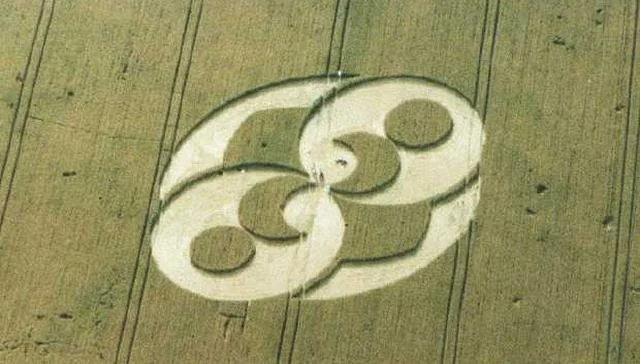
One of the factors that most contributed to the rise in popularity of the Roswell Stone was the alleged similarity between its symbols and a crop circle that appeared in England in 1996—one of the most complex ever recorded.
This formation reportedly emerged between two flyovers of a light aircraft, leading many to claim that it could not have been produced by human means within such a short interval.
The association was immediate.
For UFO enthusiasts, this was not coincidence—it was language. A recurring pattern. A “signature” of non-human intelligences manifesting both in English fields and in the American desert.
But this interpretation raises a fundamental question:
Are we observing a real pattern—or projecting meaning onto abstract forms?
The human brain is highly specialized in pattern recognition. This ability was essential for our evolutionary survival: identifying threats, recognizing faces, anticipating behavior.
However, this same mechanism can produce distortions.
Phenomena such as pareidolia (seeing faces in objects) and apophenia (perceiving connections where none exist) demonstrate that perception is not always a faithful reflection of reality—but rather an interpretative construction.
In this context, the similarity between symbols may be less evidence and more a reflection of our own tendency to connect dots.
The “anomalous” properties: between the unknown and exaggeration
Another aspect frequently cited in narratives about the Roswell Stone involves its supposed magnetic behavior.
Reports claim that the stone reacts to external magnetic fields, rotating in different directions regardless of its orientation. Radiographic examinations are said to have shown that the object is solid, with no internal cavities or hidden mechanisms.
For many, this would be proof of unknown technology.
But here, a fundamental scientific principle applies:
Extraordinary claims require extraordinary evidence.
From a geological and physical perspective, there are plausible explanations for unusual behavior:
- Minerals such as magnetite naturally possess magnetic properties
- Irregular mass distribution can produce unexpected motion
- Interactions with external magnetic fields can generate torque
- Surface friction plays a critical role in movement dynamics
In other words, the fact that something appears unusual does not make it inexplicable—it simply demands deeper analysis.
And, so far, that level of rigorous analysis has never been presented in a verifiable way.
The problem of evidence: when mystery depends on the absence of proof
One of the weakest aspects of the Roswell Stone narrative is the lack of solid scientific documentation.
There are no:
- Peer-reviewed studies
- Formal archaeological records
- Clear chain of custody
- Detailed, replicable laboratory data
The analyses mentioned in documentaries and reports rarely include essential information: researcher names, methodologies, or quantitative results.
In science, this is crucial.
Without transparency, there is no validation.
Without validation, there is no evidence.
And without evidence, any hypothesis—no matter how fascinating—remains within the realm of speculation.
Crop circles and culture: a largely explained phenomenon
The association with crop circles also loses strength when examined in light of evidence accumulated over recent decades.
Numerous groups have demonstrated, in practice, the ability to create highly complex formations using relatively simple techniques: wooden boards, ropes, geometric planning, and coordinated teamwork.
Additionally, many crop circles display features indicative of human origin:
- Subtle geometric imperfections
- Entry and exit marks
- Patterns consistent with manual intervention
This does not entirely eliminate mystery in every case, but it significantly reduces the need for extraordinary explanations.
Roswell as an archetype: the weight of context
Perhaps the most important key to understanding the Roswell Stone lies not in the object itself, but in the context in which it appears.
Roswell is no longer just a place.
It is a symbol.
A modern archetype representing:
- Government secrecy
- Hidden technology
- Extraterrestrial contact
- Global conspiracy
Within this framework, any object associated with the region is automatically imbued with amplified meaning.
The Roswell Stone did not need to prove much.
It only needed to exist—in the right place.
Why do we want to believe?
This may be the most important question of all.
Why do narratives like this continue to captivate so many people?
The answer lies not only in the possibility of extraterrestrial life—which is, in itself, a legitimate scientific question—but in something deeper:
The human need for transcendence.
We live in an increasingly explained world.
Increasingly predictable.
Increasingly measurable.
And yet, we continue to seek mystery.
We are drawn to what escapes logic.
To what resists equations.
To what reminds us that there may still be something beyond.
In this sense, the Roswell Stone is not just an object.
It is a narrative.
And narratives carry power.
Between skepticism and fascination
Adopting a skeptical stance does not mean rejecting the unknown.
On the contrary.
It means respecting it enough to investigate it rigorously.
So far, there is no solid evidence supporting an extraterrestrial origin for the Roswell Stone. The most plausible explanation remains the simplest: it is likely a modern object, possibly modified by human hands, that gained notoriety due to its insertion into a highly symbolic context.
But this does not diminish its significance.
Because the value of the Roswell Stone lies not in what it proves—
but in what it provokes.
The stone as a mirror of humanity
In the end, the Roswell Stone functions less as an alien artifact and more as a mirror.
A mirror of our curiosity.
Of our imagination.
Of our need for meaning.
It reveals something fundamental:
Even in an age of answers, we are still driven by questions.
And perhaps that is the most fascinating part of all.
Because, ultimately, the greatest mystery may not lie in the universe out there—
but in the way we choose to look at it.