The story behind the rhyme, its mysteries, and its impact on culture, education, and childhood imagination
Few characters in popular culture have endured across centuries with as much strength as Humpty Dumpty. At first glance, he seems like nothing more than a friendly egg sitting on a wall — but behind this simple image lies a rich story filled with interpretations, symbolism, and applications that go far beyond a children’s rhyme.
In this article, we will dive deeply into the origins, hidden meanings, historical theories, curiosities, and, most importantly, the role of Humpty Dumpty in psychopedagogy and children’s cognitive development.
The origin of the rhyme: simplicity with depth
The earliest recorded appearance of Humpty Dumpty as a nursery rhyme dates back to the 18th century in England. The most widely known version reads:
“Humpty Dumpty sat on a wall,
Humpty Dumpty had a great fall;
All the king’s horses and all the king’s men
Couldn’t put Humpty together again.”
What immediately stands out is the absence of any explanation about who or what Humpty Dumpty actually is. There is no mention of an egg. There is no physical description. There is only an event: an irreversible fall.
And it is precisely this ambiguity that opens the door to interpretation — and to the symbolic power of the story.
So… is Humpty Dumpty really an egg?
Interestingly, not at first.
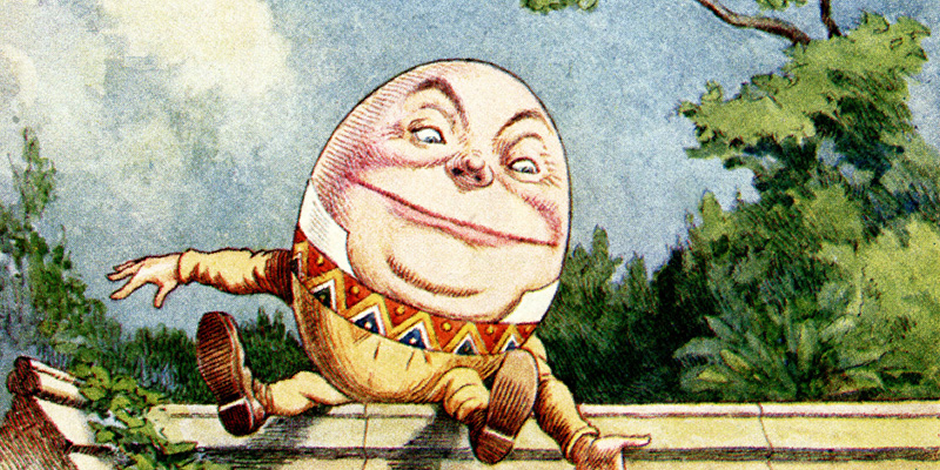
The definitive association with an egg emerged mainly after his appearance in Through the Looking-Glass, by Lewis Carroll, published in 1871. In this work, a sequel to Alice’s Adventures in Wonderland, Humpty Dumpty is explicitly portrayed as an anthropomorphic egg, complete with a distinct personality, intellectual arrogance, and a peculiar way of interpreting language.
From that point on, the image became fixed:
- Oval head
- Fragile body
- Unstable balance
- And an inevitable fate
This visual representation became so strong that today it is almost impossible to separate Humpty Dumpty from the idea of an egg.
Historical theories: who (or what) was Humpty Dumpty?
Over time, historians and enthusiasts have tried to uncover the true origin of the character. Several theories stand out:
A cannon from the English Civil War
One of the most popular hypotheses suggests that Humpty Dumpty was actually a cannon placed on a fortress wall during the English Civil War in the 17th century.
According to this theory:
- The cannon was positioned on top of a wall
- During an attack, the wall was damaged
- The cannon fell
- It was too heavy to be lifted back into place
This interpretation aligns perfectly with the rhyme:
- “sat on a wall” → positioned on the wall
- “had a great fall” → fell during the attack
- “couldn’t be put together again” → impossible to restore
Although there is no definitive proof, the theory remains compelling and widely discussed.
A political metaphor
Another interpretation suggests that Humpty Dumpty represents a political figure — possibly connected to the fall of King Charles I of England, who was executed in 1649.
In this reading:
- The “fall” is symbolic rather than physical
- The inability to “put him together again” represents irreversibility
- The “king’s men” symbolize failed attempts to restore power
This transforms the rhyme into a subtle political commentary, which was not uncommon in times of instability.
A children’s riddle
Perhaps the simplest — and one of the most plausible — explanations is that Humpty Dumpty was originally a riddle disguised as a rhyme.
At the time, “Humpty Dumpty” was a term used to describe something:
- Clumsy
- Unstable
- Difficult to repair once broken
In this sense, the rhyme can be understood as a hidden question:
What, once broken, cannot be put back together?
Answer: an egg.
The symbolism of the fall: a universal lesson
One of the reasons Humpty Dumpty has survived for centuries is its symbolic power.
The story touches on a deeply human theme:
- Fragility
- Error
- Irreversible consequences
Even in its simplicity, the message is striking:
Not everything can be fixed.
And even more importantly:
Not all power is enough to solve every problem.
This idea resonates across different aspects of life:
- Personal relationships
- Financial decisions
- Professional choices
- Emotional development
At its core, Humpty Dumpty is a metaphor about limits.
Humpty Dumpty in child psychopedagogy
Here lies one of the most fascinating — and often overlooked — aspects of the character.
The rhyme is widely used in early childhood education for several important reasons:
Developing cause-and-effect understanding
The structure of the story is clear:
- Action: sitting on the wall
- Consequence: the fall
- Outcome: irreversible damage
This helps children understand:
- The relationship between actions and consequences
- Logical sequencing
- Predictability
Introducing the concept of irreversibility
For young children, the idea that something cannot be fixed is complex.
Humpty Dumpty introduces this concept in a symbolic and emotionally safe way:
- No graphic elements
- No explicit trauma
- Only the recognition of the result
This allows educators to work on:
- Frustration
- Acceptance
- Boundaries
Encouraging imagination and interpretation
Because the rhyme never defines what Humpty Dumpty is, it invites:
- Free imagination
- Creative interpretation
- Narrative construction
Teachers and parents often use this to:
- Ask children to draw the character
- Create alternative endings
- Invent new versions of the story
Supporting language development
Nursery rhymes like this one are powerful tools for developing:
- Rhythm
- Memory
- Vocabulary
- Phonological awareness
They are also widely used in bilingual education, especially for introducing English at an early age.
Humpty Dumpty in popular culture
Over the centuries, Humpty Dumpty has been reinterpreted countless times.
Literature
His most famous appearance beyond the rhyme is in Through the Looking-Glass, where he:
- Engages in discussions about semantics
- Plays with the meaning of words
- Represents control over language
This version is far more philosophical and complex than the original.
Film and animation
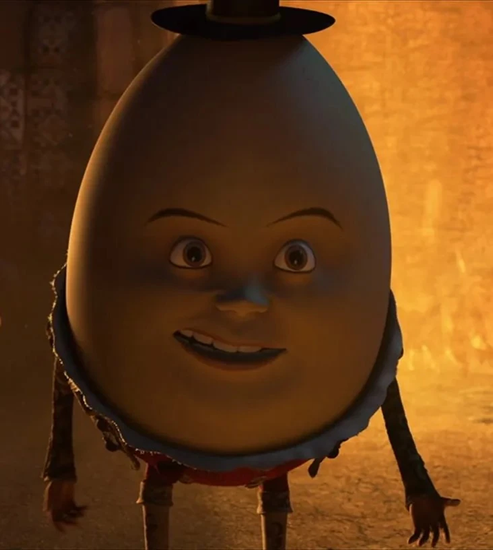
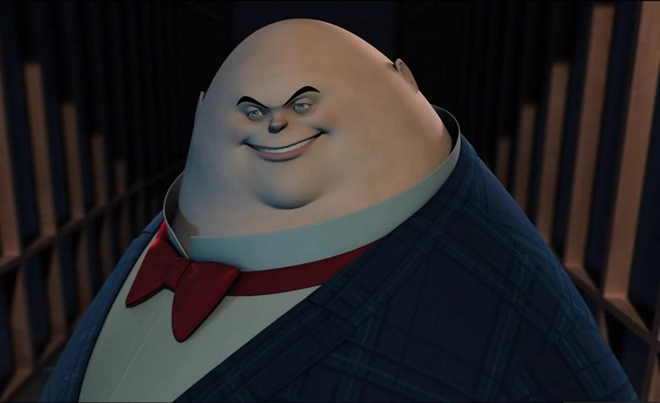
In modern adaptations, Humpty Dumpty often appears as:
- A comic character
- A tragic figure
- A symbol of arrogance or fragility
He has become an archetype: the character who falls and cannot be restored.
Games and digital media
In interactive media, Humpty Dumpty is often used as:
- A puzzle element
- A broken character to be reassembled
- A symbolic representation of failure
Curiosities about Humpty Dumpty
Here are some lesser-known facts:
The egg was never mentioned originally
The egg image is a later construction — now universally accepted.
It began as a riddle
Early versions of the rhyme functioned as a puzzle.
It is studied in linguistics
The character in Lewis Carroll’s work is often analyzed in philosophy of language.
It may have military origins
The cannon theory is still widely debated.
It is globally recognized
Few children’s characters have such universal recognition.
Modern applications: beyond childhood
Humpty Dumpty is also used in adult contexts:
Business and management
As a metaphor for:
- Irreversible crises
- Structural failures
- Critical decision-making
Psychology
As a symbol of:
- Emotional fragility
- Breakdown
- Limits of recovery
Law and politics
As an example of:
- Situations without return
- Institutional collapse
Why Humpty Dumpty still matters
In an increasingly complex world, Humpty Dumpty remains relevant because it speaks to something essential:
- Not everything can be repaired
- Not every mistake has a solution
- Not all power can fix everything
And perhaps the greatest lesson is:
Balance matters.
Conclusion
Humpty Dumpty is far more than a children’s character. It is:
- A historical enigma
- A philosophical symbol
- An educational tool
- A cultural icon
From a possible war cannon to a talking egg in literature, its journey shows how simple stories can carry profound meaning.
And perhaps that is exactly why it never truly disappeared.
Even after the fall.